

Snow Foam or APC Pre-Wash? Two Ways, One Goal—Touchless Cleaning
Two bottles stand side-by-side in the wash bay: the pink-foaming Gentle Snow Foam and the inconspicuous green all-purpose cleaner. Both promise a pre-wash. Only one of them puts your coating at risk if you use it incorrectly. And that happens more often than most people think.
Snow Foam and APC are not alternatives, but colleagues. One works broadly and gently, the other precisely and powerfully. Those who know both can wash more touchlessly, faster, and more gently—without rubbing the coating off the paint.
Same Job, Two Tools—and One Will Cost You Your Coating
Snow Foam is a pH-neutral surfactant that lies on the paint as a foam carpet. APC—short for All-Purpose Cleaner—is an alkaline cleaner that chemically breaks down fats and proteins. That sounds similar, but in terms of effect, they are two different worlds.
Both belong in the pre-wash, both work touchlessly, both reduce dirt on the paint before the wash mitt comes into play. The foam envelops the paint surface and loosens light dirt—dust, road grime, light pollen film, dry sand from the wheel arch. The APC directly attacks the chemical bonds in the dirt: insect proteins, brake dust-grease mixtures, engine oil, baked-on tar. The foam washes away, the APC dissolves.
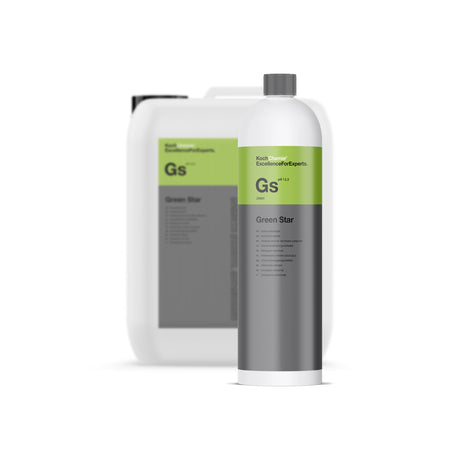
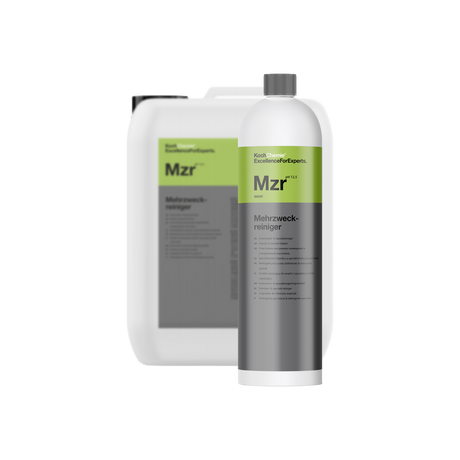
The choice between the two is not a matter of taste, but a question of the surface and the dirt. There are surfaces that an APC like Koch-Chemie Green Star should not touch: ceramic coatings, anodized aluminum, magnesium rims, Alcantara, synthetic leather, coated interior parts. And there are contaminations that a Snow Foam like Gentle Snow Foam GSF will pass by as if nothing happened: dried insects on the bumper, greasy brake dust layers in the wheel arch, resin and sap from linden and poplars. The most common mistake in the hobby garage: spraying APC as a foam over the entire bodywork. With each application, this costs you a millimeter of ceramic topcoat—not visible, but measurable.
Gentle Snow Foam GSF: pH 7.5, broad application, Coating-safe
With a pH of 7.5, Gentle Snow Foam GSF stays exactly within the zone where waxes, sealants, and ceramic coatings are not damaged—even with weekly use over months. This is the core argument for any coated vehicle.
The foam is created in the foam cannon of a high-pressure washer with 20 ml of product per liter of water. On the vehicle, a thick, densely structured foam carpet forms, which adheres for five to ten minutes without drying out—it holds even at fifteen degrees and light sun. During this time, the surfactants loosen loose dirt from the surface; when rinsed off, the water carries most of it away before the wash mitt even touches the paint. For a foam lance on a low-pressure washer, the dosage is 80 to 100 ml per liter—depending on water hardness. Those with hard tap water from the Ruhr area tend to use 100 ml, because calcium and magnesium partially bind the surfactants. Soft rainwater or deionized water will suffice with 80 ml.
What the GSF really excels at is regular maintenance washing. The scent is sweet and fruity, the foam is dense, and it rinses off cleanly—no streaks, no greasy film, no haziness on the clear coat. What it cannot do: stubborn insect residues, tar, rust film, baked-on brake dust. For everyday use—parking twice a week, one long-distance trip, spring to autumn—it is entirely sufficient. At 12.95 Euros per liter and a dosage of 20 ml in the foam cannon, each bottle yields about fifty pre-washes. That's under 30 cents per wash, product cost only, excluding water and electricity.
Two practical tips that are not in any data sheet. First: The GSF adheres better to dry paint than to pre-wetted paint—a brief shading is enough; a pre-rinse with pressurized water will wash away the top surfactants before they can work. Second: Below ten degrees Celsius, the foam structure loses its stability, and the carpet falls off faster. In late autumn and early spring, it is worth slightly increasing the dosage to 25 ml per liter to achieve the same adherence time.

Green Star: pH 12.5, targeted, uncompromising
The Koch-Chemie Green Star is a highly concentrated alkaline all-purpose cleaner with a pH of 12.5, which chemically decomposes organic contaminants instead of rinsing them away. The color is eponymous, the effect industrial.
Alkalinity is not a byproduct, but the active principle. Fats are saponified, proteins denatured, resins broken down. This is precisely why Green Star dissolves baked-on insects, greasy brake dust mixtures, old wax layers, and polishing residues where a neutral foam only rinses the surface. The dosage deserves its own paragraph because it reveals the product's versatility. Depending on the application, the range extends from 1:5 for workshop floors or heavily oiled motorcycles, to 1:10 as an insect pre-soak before pre-washing, 1:20 for plastics, rubber, and engine compartment parts, up to 1:50 for normal maintenance washing among friends. For over ninety percent of car care situations, 30 ml of Green Star per liter of water is sufficient—this yields about 33 liters of ready-to-use solution from a 1-liter bottle.
At 6.08 Euros per liter of concentrate and a typical 1:10 dilution, one bottle makes ten liters of ready-to-use solution—that's about a third of the snow foam's per-liter price and quickly pays off for frequent drivers. Those who work in a trade business or car dealership can directly opt for the 5-liter canister at 27 Euros or the 11-kilo container at just under 55 Euros—the liter price then drops below 5 Euros. However, the restrictions are strict and must be taken seriously. A maximum of three minutes exposure time, never in the sun, taboo on anodized aluminum, magnesium rims, ceramic coatings, synthetic leather, and coated interior parts. Prepared solutions are no longer fully effective 24 hours later because the carbon dioxide from the air reacts with the caustic soda and lowers the pH value. If you have a spray bottle of Green Star from last weekend sitting on the shelf, it's better to discard it and mix a fresh batch. Second tough point: Green Star belongs on a cold, dry surface. Not on a sun-warmed fender after half an hour in the midday sun.
Six scenarios, two decisions
The choice between Snow Foam and APC is not determined by the product, but by the type of dirt and the paint surface in front of you. The following table shows typical situations in a private garage and a detailing corner on the weekend.
| Scenario | Gentle Snow Foam GSF | Green Star |
|---|---|---|
| Weekly maintenance wash, coated | Yes — 20 ml/L foam cannon | No — attacks coating |
| Paint after long drive with insects | Only superficial, not sufficient | Yes — 1:10 on front and sills |
| Rims and wheel arches | No — too weak | Yes — 1:10, not on magnesium |
| Engine bay and plastic parts | No — too broad | Yes — 1:20, cover electronics |
| Spring wash after winter | As broad pre-wash | As spot treatment on sills |
| Paint without coating, only wax | Yes — regularly, 20 ml/L | Yes — for heavy soiling |
The most common mistake in a hobby garage: spraying Green Star broadly onto the paint of a ceramic-coated vehicle, assuming that a stronger cleaner will also clean faster. The opposite is true. With each application, the outermost adhesive layer of the coating is measurably reduced—after ten to fifteen washes, the durability is significantly shorter than promised by the manufacturer. The coating still shines, still beads, but the protection against UV and dirt breaks down earlier. If you have a coating, keep Green Star away from large painted areas and reserve it for wheel arches, sills, door jambs, and the front end in case of severe insect infestation. For surface washing, use Gentle Snow Foam. If you want to choose between several foam cleaners, you can find the complete selection in the Snow Foam collection.

What foam can do, what APC dissolves
The GSF is an encapsulator, the Green Star a dissolver. This determines what ends up in your wastewater—and how much work the wash mitt still has to do when actual contact with the paint begins.
Snow Foam mechanically removes dirt. Surfactants reduce the surface tension of water from about 72 to below 30 millinewtons per meter, the water penetrates particles, the foam carpet keeps everything moist until the high-pressure jet washes it away. You see the effect on the car body: The foam runs off dirty gray, at the bottom of the sill, dark sludge separates from the light foam. After the second pass, the car is already significantly brighter before the mitt is even unpacked. Foam works visibly.
APC, on the other hand, works at a molecular level, and that is less visible. Alkaline molecules split fat esters into glycerol and soaps—known as saponification. Proteins unfold and lose their structure, which is why baked-on insects come off like butter after two minutes of dwell time. What was firmly stuck to the surface then lies as a dissolved layer on the paint and can be rinsed off with little pressure. That's why Green Star works in places where water and surfactants alone fail: resin, old tar, baked-on brake dust-grease mixtures, dried insects after two weeks of long-distance driving, old wax layers before polishing.
The second difference is reach. GSF gets everywhere the foam blanket falls—large areas, high coverage, roof included, without you having to walk from front to back. Green Star works where you deliberately spray it—every centimeter is your decision. Trying to apply APC broadly with a foam cannon dilutes it below its effective concentration and simultaneously coats the coating with alkalinity. Both are suboptimal and regularly appear in forum threads when someone wonders why their coating has deteriorated. The rule is simple: foam for large areas, APC for spots.
A third difference, which few mention: the environmental footprint. GSF is readily biodegradable and passes through typical greywater treatment plants without problems. Green Star is NTA-free and declared as a concentrate, but its strong alkalinity requires neutralization—anyone washing at home on a paved driveway should keep this in mind and wash where wastewater drains into the sewer, not into the garden.
Our Workflow: Both in the set, not against each other
In our wash bay, GSF and Green Star stand side by side—not as rivals, but as two stations in the same process. If you only buy one of them, you’re buying too little or too much.
The procedure for a normally dirty car in spring looks like this: First, Green Star 1:10 from a pump spray bottle on the front, sills, inner wheel arches, door jambs, and the lower twenty centimeters of the car's sides. Let it dwell for three minutes, then rinse off with gentle pressurized water—not with a sharp nozzle jet, but with a flat fan. After that, apply GSF broadly from the foam cannon to the entire body: roof, bonnet, windows, doors, rear. Let it sit for five minutes, rinse with pressurized water, and only then start contact washing with a mitt using the two-bucket method. This isn’t extra work, but a redistribution. You transfer less dirt across the paint with the wash mitt, significantly reduce the risk of wash marks, and save shampoo because the paint is already about eighty percent clean before the main wash.
If you have a foam lance attachment for a low-pressure washer, dose the GSF at 80 to 100 ml per liter. If you use a real foam cannon on a high-pressure washer, stick to 20 ml per liter. Green Star goes into a separate pump spray bottle—never the same one you use for snow foam or shampoo. Alkaline residues on the valve or in the spray line are enough to gradually attack your next coating. Label the bottle, write the dilution on a small sticker, and rinse the bottle with clear water after each use. If you're just coming out of winter and have the spring wash ahead of you, you'll find the appropriate concentrates in our pre-cleaner assortment. Two products, clear roles, no competition—and a paint that looks after washing as if someone else cared for it.