

Acid or polish: where the water spot sits decides it
White rings on the bonnet that stay put after the wash. We get this question every week, often with the add-on "baked on". Some spots are only a few days old, some have been sitting on a ceramic coating for three, four months. The question behind it is almost always the same: is a water spot remover enough, or do I need to polish?
You remove dried-on water spots in a fixed order: wash, inspect, let an acidic water spot remover dwell briefly, rinse. If the spot is still visible under a film of water afterwards, it sits in the clear coat. Then only a finishing polish will do, followed by a fresh sealant.
Dried-on water spots are mineral salts on the clear coat
Dried-on water spots form when a water droplet evaporates on the paint and leaves its mineral salts behind, mostly limescale from hard water.
Tap water is never just water. Depending on where you live, a litre carries a few hundred milligrams of dissolved minerals, mainly calcium and magnesium. When the droplet evaporates, only the water disappears. The salts stay exactly where the edge of the droplet was. That is why limescale spots almost always look like rings rather than patches. Rainwater is softer, but it picks up dust, pollen and industrial fallout on its way down. Those residues dry into a ring as well.
What matters for the treatment is which stage the spot is at. In the first stage the mineral salts sit loosely on top of the paint, and a normal wash often takes them off. In the second stage they have bonded firmly to the surface. Shampoo slides straight over them, but a mild acid dissolves the mineral deposits, because limescale breaks down in acid. In the third stage the spot has attacked the clear coat itself. Now there is a tiny etch with a sharp edge, and no chemistry can fill that back in.
From the outside all three stages look the same: a pale ring that bends the light differently from the paint next to it. That is why the order matters so much. If you reach for the polish straight away, you take off clear coat for a spot an acid would have dissolved in a minute. If you only ever use acid, you will never get a third-stage spot out.
The longer limescale spots sit, the more likely they bite into the clear coat
Limescale spots get harder to remove with every day, every hour of sun and every shower, because heat speeds up the reaction between minerals and clear coat.
Dark paint heats up to 70 to 80 degrees in summer sun. As a rule of thumb from chemistry, many reactions roughly double with every 10 degrees more. A droplet that dries on a hot bonnet therefore does not stay on the surface for long. When the next rain arrives, it loosens the ring briefly, and the sun dries it back on. Every one of those cycles moves the spot one stage further.
The clear coat on a production car is only 35 to 50 micrometres thick, about half the thickness of a sheet of paper. It is the protective layer for everything underneath. A finishing polish removes only one to three micrometres of it per pass. That is not much, but it never grows back. Every spot you dissolve with chemistry instead of polish saves you some of that reserve.
Autumn adds something else. The days are short, the car stays wet for hours after rain and dries slowly. Wet leaves on the bonnet release tannins that leave dark edges on top of everything else. And in winter, road salt follows. It attracts moisture and keeps the spots wet for longer. If you want to build up a sealant before winter, remove the limescale spots first. Otherwise you seal the spots in, and they stay on the paint all winter.
Here in Nordhorn it is overcast and around 10 degrees today, with rain forecast from Wednesday. Cool, dry days like this are good for working with acid. The panel is cold, nothing flashes off too fast, and the new sealant will be on before the rain.
Wash and inspect: does the spot sit on the clear coat or in it?
Before any water spot remover goes on the paint, you wash the car thoroughly and check every spot in the light, because only on clean paint can you see what is really left.
The first step is a normal hand wash with two buckets and a shampoo. It lifts dust and road grime and already clears many first-stage spots. Acid on unwashed paint is a bad idea. Every wipe drags grit across the surface, and the water spot remover has to work through the dirt before it reaches the limescale. Afterwards, dry the car with a large, soft microfibre cloth without pressure. How to avoid new spots while doing that is covered in our article on myths about drying your car.
The second step is the inspection. Move the car into the shade or the garage and shine a torch or your phone light across the panels at a low angle. In raking light you can see which rings survived the wash. Then run a fingernail across a ring. If you feel an edge, the spot is deep enough that even a finishing polish is reaching its limit. In that case a cutting compound or a trip to a professional detailer is the honest answer.
On the vast majority of spots your nail feels nothing. For those, the acid comes next. Before that, check whether your car wears a ceramic coating. That decides which product you use. Some water spot removers are made for ceramic, while others are expressly ruled out on ceramic by the manufacturer.
Acid first, then polish, sealant last
An acidic water spot remover dissolves limescale spots in 30 to 60 seconds, after which the area is rinsed and neutralised. Only what is still visible then gets polished.
The third step starts with temperature. The panel has to be cool, so in the shade and at about 10 to 25 degrees. If the metal is still warm to the touch after a drive, wait five minutes. On warm paint the acid dries before it works and leaves a ring of its own. Always work in small sections, about half a bonnet. That keeps the dwell time under control.
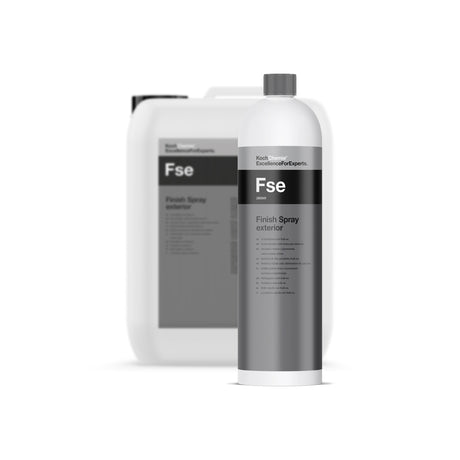
Spray the water spot remover onto the panel and let it dwell briefly. For stubborn spots, Koch-Chemie gives 30 to 60 seconds for the Fse, no longer. Then wipe over it with a folded, clean microfibre cloth without pressure. The cloth should pick up the dissolved limescale, not scrub. Straight afterwards, rinse the section with clean water or wash it again with shampoo. That neutralises the acid, and nothing is left on the paint that keeps working.

Now comes the real check. Wet the spot with a little water. If it disappears under the film of water, it was a second-stage spot and it is gone. If the ring stays visible under the water, it sits in the clear coat. You can still try a second pass with acid. After that, stop. More acid will not make a spot in the clear coat any smaller, it only attacks the sealant on the panels next to it.
The fourth step is the polish, but only for the spots that are left. A finishing polish on a soft finishing pad takes off the top layer of clear coat just far enough for the edge of the spot to disappear. With a dual-action polisher on a medium speed this is quick and even. You can also manage single spots by hand. Mask the area off with masking tape, polish in small circles, wipe off and check in raking light. Better twice gently than once too hard.
After that the panel needs protection. The acid has stripped wax and sealant from the treated areas, and the polish has removed it completely. Without a fresh sealant the paint is left bare, and the next limescale spots arrive faster than the old ones left. A spray sealant on the cleaned paint brings the beading back in a few minutes.
Sun and dry wiping turn spots into scratches
Most of the damage when removing water spots comes from sun, dry rubbing and household remedies with no lubrication, not from the spot itself.
The most common mistake is the sun. An acidic water spot remover on warm paint dries in seconds. Then it works too long in some places and not at all in others, and you end up with new rings instead of fewer. Koch-Chemie expressly rules out the Scf on warm paint in the sun. The same applies to every other acidic product, even if it is not printed on every label.
The second mistake is wiping dry. If you try to rub a limescale spot away with a finger or a dry cloth, you push the hard mineral crystals across the paint. The result is fine scratches around the spot. A water spot remover or a quick detailer brings lubrication with it. The cloth runs on a film and not on the crystals.
That is also why vinegar is a bad idea. The acid in household vinegar does dissolve limescale, but vinegar has no lubricants. So you are rubbing dry on the paint with diluted acid. On top of that, nobody knows how strong the vinegar in the cupboard is or how long it can safely sit on the paint. Glass cleaner does not help either, because it is made for grease and grime and barely touches limescale. And polishing as a first step, before the acid has done its job, is the most expensive mistake. The polish takes the mineral crystals into the pad and drags them across the paint, so you polish scratches in.
Cars with a ceramic coating come with a quirk. A good ceramic coating makes water gather into round droplets. If those droplets are left standing in the sun, they dry with their mineral salts in exactly one spot. That is why you often see limescale spots more clearly on coated cars than on uncoated ones. The fix is not a different product, but drying after every wash and after rain as soon as the sun comes out. Why heat plays the biggest part in this is explained in detail in our article on removing water spots from your car in the heat.

Five products cover everything from water spot remover to sealant
For dried-on water spots on paint you need a water spot remover for your surface, a finishing polish for the leftovers and a sealant for protection afterwards.
On normal paint, waxed or with a simple sealant, the Koch-Chemie Finish Spray Exterior "Fse" Quick Detailer with Kalk-EX is our first choice. It is quick detailer and water spot remover in one, clearly acidic at pH 2.5 according to the safety data sheet. Two to three sprays are enough for one panel. Koch-Chemie names its limit itself: it is not intended for ceramic coatings or fresh wax. Verified buyers on Trusted Shops have given it five stars across the board so far.
For ceramic-coated cars, the Koch-Chemie Spotless Ceramic Finish "Scf" Water Spot Remover for Ceramic-Coated Surfaces is the one made for the job. It works with glycolic acid, is a little milder at pH 3.5 and is gentle on the ceramic layer. According to the safety data sheet it can cause serious eye damage, so wear safety glasses. Koch-Chemie rules it out for limescale crusts that are months old and for warm paint in the sun. For the three, four month old spots from the customer question above, that means it is worth one attempt, and then the water test decides.
For the spots that remain, you reach for the SONAX PROFILINE NP "03-06" High-Gloss Polish (Finish). It works with a dual-action polisher on a soft finishing pad, and by hand on small areas. For individual spots the 250 ml bottle lasts a long time. It leaves no protective film, so a sealant always follows. If you work without a machine and only have a few spots, go for the Dr. Wack "A1" A1 "ULTIMA Show & Shine Polish" Polish. It is made for hand work on clear coat and brings protection with carnauba that lasts up to three months.
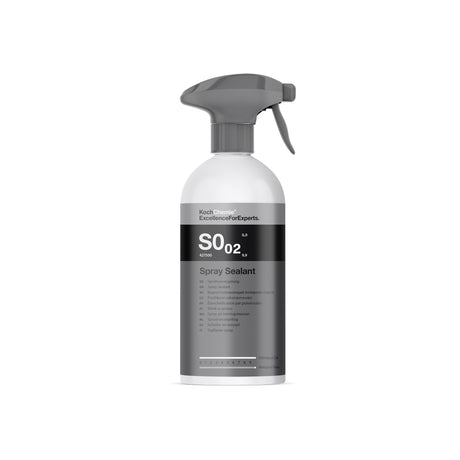
Last comes the Koch-Chemie Spray Sealant "S0.02" Spray Sealant on the cleaned paint. Spray it on, spread it with one microfibre cloth, buff off with a second. It brings the beading back on the treated panels, and before the rain arrives. On Trusted Shops it sits at seven reviews with full marks. You will find more products for every surface in the water spot remover category, and the matching polishes under finishing polishes.

Detailing1-Insight: When someone writes that their spots are "baked on", we do not jump straight to polish. We recommend the water test after the first pass with acid. Wet the spot with water and look across it in raking light. If the ring disappears under the film of water, it was only stubborn, and a second pass finishes the job. If it stays visible, it sits in the clear coat, and then we polish exactly that spot and nothing else. That way the clear coat stays intact where it never took any damage, and that is usually almost the whole panel.
No time for the whole post? Get it summarized:
Add Detailing1 as a preferred source on Google