How often can you polish a car? Your clear coat has eight microns
Daniel von Detailing1 |


Kränzle
Replacement Container for "Foam Lance"
Easy organization of cleaning foam


Kränzle
Screw Cap for "Foam Lance Spare Container"
Screw cap for secure and practical storage


Kränzle
Kränzle Foam Lance with Bottle for "D10/D12"
Adjustable spray angle with high-quality container for snow foam


bigboi
Perfect vehicle cleaning with innovative foam technology


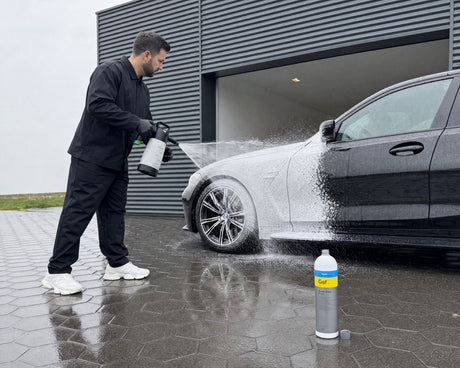
Snow foams for lance and pressure sprayer.

Kränzle
"Starlet 4" long pressure washer gun for "D12"
Ergonomic high-pressure washer gun for professionals

Kränzle
"Starlet 3" short pressure washer gun for "D12"
High-pressure cleaner gun with ergonomic design and high performance


Kränzle
"K 1050 TST" Pressure Washer with Hose Reel
Compact and powerful pressure washer with hose reel


Kränzle
"K 1050 P" Pressure Washer (Compact & Portable)
Compact high-pressure cleaner for private users

Kränzle
"Quickly" Pressure Washer (Cold Water)
High-pressure cleaner for home with professional quality


Kränzle
Replacement Container with Screw-Cap Set for "Foam Lance"
Replacement Tank Set for Flexible Vehicle Cleaning


Kränzle
The perfect pressure washer for your home.
What does a pressure washer actually do on a car? It rinses off loosened dirt — the chemistry has to loosen it first. What matters more than the bar rating on the box is flow rate, nozzle distance and the angle to the paint. At Detailing1 you'll find machines and accessories from Kränzle and bigboi.
Pressure washers are pumps that compress tap water to 100 to 200 bar and throw it at the surface through a nozzle as a flat jet. On a car they handle the rinse: they carry off pre-cleaner, foam and softened road grime before your wash mitt or drying towel ever touch the panel. The cleaning itself is done by the chemistry — the machine just hauls it away.
Day-to-day from Detailing1: We get a lot of questions about hazy films and dull spots that show up in raking light after a wash. Almost every time the same sequence is behind it: the dirt was stuck fast, the distance got shortened, and the rotary nozzle came out at the end. That spinning point jet belongs on paving and render, not on painted metal. If a spot still holds after the rinse, the answer is a second pass with pre-cleaner and more dwell time, not less distance. Water under pressure is patient — clear coat isn't.
A pressure washer doesn't loosen dirt. It carries off what's already been softened chemically, and it does that without ever touching the paint.
Road grime on paint is a mix of dust, tyre rubber, brake dust, salt and oily residue. What holds it together is the greasy part. Water on its own can't get at that, no matter how much pressure you throw at it, because water and grease simply don't mix.
That's why chemistry comes before every rinse. An alkaline pre-cleaner breaks the grease film open, and foam off the lance keeps the active ingredient on the vertical panel for the minutes it needs. Only then does the water jet have something it can carry away.
Flip that order around and you're fighting physics, and you feel it right where it hurts. The dirt stays put, the pressure climbs, the distance shrinks. What you end up with isn't a clean car but a dull patch under the door edge.
What we see day-to-day: the biggest jumps in results almost never come from a stronger machine. They come from a second round of pre-cleaner, from five more minutes of dwell time, and from keeping the panel in the shade while you work it instead of the midday sun.
That's also why, with beginners, we ask about the chemistry first and the machine second. A mid-range cold-water unit with a good pre-cleaner beats the model that costs twice as much and just fires tap water at bare muck.
On every box the bar figure is splashed big across the front and the flow rate sits small on the back. For washing a car, that order is exactly the wrong way round.
Pressure is the force a jet hits the surface with. Flow rate is how much water runs over that surface per hour. Dirt doesn't get smashed apart, it gets flushed away — and flushing is a question of volume, not punch.
The two are tied together because they share the same motor output. Rule of thumb: bar times litres per minute divided by 600 gives you the hydraulic power in kilowatts. A household socket caps the whole thing at around 3.4 kilowatts, and no manufacturer shifts that ceiling.
In practice: a machine at 110 bar and 600 litres an hour rinses a car clear faster than one at 160 bar and 380 litres, even though the second number looks more impressive on the box. On paint you never work at full pressure anyway.
The supply sets the next limit. A half-inch garden hose on a normal house connection delivers roughly 600 to 900 litres an hour. A machine that wants more will draw air and start to hammer. If you're buying big, check first what the tap actually gives you.
Do the maths on water use once before you commit to a big machine. Eight minutes of spraying at 500 litres an hour is about 65 litres of water for one lap around the car. At 1,000 litres an hour it's double that in the same time.
Two things decide what actually reaches the panel, and both are in your hands: how far the nozzle sits from the surface, and the angle the jet hits at.
The flat jet with a 25-degree spread is the right call on a car. It fans out and spreads its energy over a width that grows with distance. From ten centimetres it hits a narrow strip hard; from thirty it puts the same energy across three times the width.
That's why thirty centimetres is the baseline you walk up to a car with. On the underbody, in the wheel wells and on the wheel itself you can go closer. On paint, on glass and on anything that's bonded on, that distance stays put.
Angle is the other half of the sum. A jet that hits dead-on dumps all its energy in that one spot. A jet led in flat skims the surface and pushes the film of water and dirt along ahead of it. On a car you work flat, and top to bottom.
The rotary nozzle — dirt blaster in the trade — bundles the jet into a point and sets it spinning. On concrete and paving it's a blessing. On clear coat, on wrap and on any plastic part it's the fastest route to a mark you won't polish back out.
We often see the first damage happen not on the paint at all, but on the plate surround, the badge or the trim strip. Those parts are glued or clipped on, and they don't stand up to a point jet from close range. If you have to get in nearer there, back the pressure off first.
On a modern car there's a good dozen spots where the high-pressure jet does more harm than the dirt it's meant to take off.
Wraps and paint protection film are the classic case. The surface itself holds up fine; the edge doesn't. A jet that runs into a film edge from the side lifts it, and from there water creeps underneath. Run the jet parallel to the edge, never into it, and stay at thirty centimetres at least.
Seals are the second zone. Door rubbers, window channel strips and boot seals are built for rain, not for 150 bar from ten centimetres. Water behind a seal rarely shows up straight away — it turns up two weeks later as a damp footwell or a window fogging from the inside.
Then there's the electronics on the outer skin. Reversing camera, ultrasonic sensors in the bumper, radar module behind the badge, door handles with a keyless antenna. All of it is protected against splash water and none of it is built for a directed jet from close range.
On the underbody and in the engine bay the same logic applies to different parts. Radiator and condenser fins fold over if you catch them at an angle, and a folded block of fins cools worse. CV boots and wheel-bearing seals don't like a point jet from five centimetres.
Two spots often drop off the back. A fabric roof on a convertible is impregnated across the surface and open at the seams, and a close jet drives water through there. And in the engine bay the connectors are sealed against moisture, not against pressure from the side. In both zones keep well back, or leave them out altogether.
And an honest limit for the whole category: if the paint is open at a stone chip or flaking at an edge, the jet lifts it further. No machine and no accessory helps there — only touching it in. If you know a spot like that on your car, deliberately give it a miss while you rinse.
The pressure washer comes into a clean wash routine three times, and each time it has a different job to do.
The first pass is the pre-rinse. It takes off loose sand, road salt and bug splatter before anything touches the surface. Top to bottom, flat angle, no thought for stubborn spots. Everything that runs off here can't draw a scratch later.
Then comes the chemistry. A pre-cleaner on the lower half of the car, then Snow Foam over the whole thing. The foam isn't for show, it's a delivery system: it holds the active ingredient where it's meant to work instead of letting it run off down the flank.
The second rinse takes the foam and loosened dirt with it. Again top to bottom, again with distance. Only now is the surface ready for a wash mitt to touch it without dragging grit across the clear coat. The rest is classic two-bucket car wash.
The third job is the final rinse after the shampoo. Here it pays to take the nozzle off and work with a pressureless sheet of water, because the closed film pulls more droplets off as it runs. That saves minutes on drying — and with it, the single most common source of scratches there is.
Nothing can dry on between the steps. The moment foam or pre-cleaner breaks up on a warm panel in the sun, you're left with rings of lime scale and active ingredient that you then have to soften off again. Work in the shade, and in warm weather do one side of the car at a time rather than the whole thing at once.
The foam lance is worth a sentence of its own, because it's the most commonly mismatched accessory in this category. Its nozzle bore has to suit the machine's flow rate. Too big a bore on a small machine gives you thin milk instead of foam, and hardly anyone suspects the accessory as the cause.
Before the question of which model comes the question of where. Where you wash decides the connection, the hose length and whether a stationary machine is even worth it.
At your own parking spot with a water connection and a drain, a mid-range cold-water machine is the sensible call. Around 140 bar, 600 litres an hour, ten to fifteen metres of hose so you can get around the car once without swapping sockets on the way.
If you drive to the self-service bay, you don't need your own machine — you need good chemistry and the discipline to keep that lance at a distance. Those units run at far more pressure than a hobby machine, and the brush next to them is best left alone.
On the mechanical side, two details are worth a look. A slow-runner at around 1,400 rpm lasts a lot longer than a fast-runner at 2,800, and a brass pump head forgives lime scale and frost better than an aluminium one. That's exactly how you spot a pro line.
You don't need hot water on a car. It has its place where thick layers of grease have to come off metal, and on paint it mainly brings one drawback: the surface dries off faster, and dried-on chemistry pulls exactly the rings you're trying to avoid. A cold-water machine is the right build for washing a car.
Kränzle builds in Germany and serves this build; bigboi comes out of the detailing corner. The bigger difference comes from the accessories anyway: flat-jet nozzle, foam lance with the right bore, underbody lance, a decent hose reel. The rest of the detailing kit sits one level up.
And if a machine happens to be out of stock, that's no lost wash day. The biggest lever sits before the rinse anyway: pre-cleaner, Snow Foam and a clean routine at car wash pull out more than any extra bar.
Too much choice in high pressure cleaner? Get help picking:
Daniel von Detailing1 |

Daniel von Detailing1 |

Daniel von Detailing1 |

Daniel von Detailing1 |

Daniel von Detailing1 |

Daniel von Detailing1 |

Daniel von Detailing1 |

Daniel von Detailing1 |

Daniel von Detailing1 |

Jasper von Detailing1 |

Daniel von Detailing1 |

Jasper von Detailing1 |