

5 wheel zones that each need a different wheel brush
The spokes shine, the car is freshly washed, and then your eye catches the wheel at an angle: behind it, the wheel barrel still has the same brown film as before the wash. Most of us grab a single wheel brush and expect it to reach everything. But a wheel is made up of five zones with very different space, material and dirt, and no brush in the world covers all five.
For a clean, scratch-free wheel you don't need an expensive complete set, just the right tool for each zone: flexible microfibre in the wheel barrel, a slim bristle brush at the brake caliper, soft dense fibre on the wheel face, a narrow detailing brush for the lug nut holes and a separate brush for the tyre sidewall.
1. Brake dust hides in the wheel barrel where only microfibre reaches it
The wheel barrel behind the spokes is the zone people forget most often when washing, because you hardly see it from the front. It's exactly where brake dust settles thickest, since the brakes sit right behind it.
Brake dust is largely made up of fine iron particles from the disc and pad. In city traffic they leave the brakes at 150 to 260 °C and land just as hot on the wheel barrel. If the dust sits there for weeks, it bonds with moisture and road grime into a brown crust. Push a stiff brush in and you only reach the first few centimetres. Behind that stays a ring you only notice once the wheel is off the car.
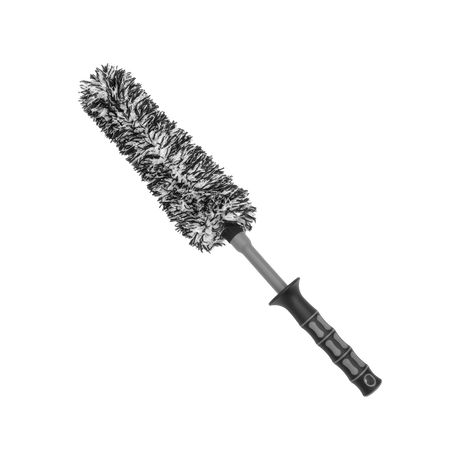
The fix is a long, flexible shaft with a microfibre head. The THE COLLECTION "Flex Brush" Microfibre Wheel Brush bends around the spokes all the way into the back of the barrel. Instead of bristles it carries a thick microfibre head that lifts brake dust instead of dragging it across the clear coat.
The brush works best when the wheel is cold, the wheel cleaner has dwelled for three to five minutes beforehand and you've given it one solid pre-rinse. Then the chemistry does the loosening and the brush only wipes away what's left. On a wheel that still feels warm after a drive, the cleaner evaporates before it can work.
One trick from daily use makes the difference here: after the pre-rinse, spray a little more wheel cleaner straight onto the microfibre head. The fibres then glide over the surface wet instead of dry, and the head lets go of the dirt more easily when you rinse it out. The limit of this brush is its thickness: microfibre barely compresses. Where the gap gets very narrow, zone 2 takes over.
2. At the brake caliper only a bristle that gives way will fit
On many sports cars, only a narrow gap is left between brake caliper and wheel barrel, and a thick microfibre head won't fit through it. Here you need a slim tool with bristles that compress.
Plastic or natural bristles can usually be squeezed down to five or six millimetres, while a microfibre head stays almost as thick as it was on the shelf. On big brake kits with calipers that reach almost to the wheel, that difference decides whether you reach the inside at all. Measure the gap once with a folding rule before you buy, rather than finding out at the wheel that nothing fits through.
On current performance models with brake discs around 380 millimetres behind 19-inch wheels, often only a few millimetres remain between caliper and wheel barrel. A thick round brush five to seven centimetres across jams there before it gets to the back of the barrel. A flat detailing brush, on the other hand, goes through on its edge and lies flat against the wheel again behind the caliper.
The Koch-Chemie Wheel & Engine Brush is made for exactly this tight spot: a flat brush with a long 42-centimetre wooden handle, China bristles and a plastic ferrule with no metal parts. The slim 50-millimetre version slips through the gap at the caliper, while the wide 75-millimetre one covers more area. Because the ferrule is metal-free, there's no bare wire exposed after years of use that could leave a mark when it knocks the wheel edge. The bristles are made for use with wheel cleaner.
Six verified reviews on Trusted Shops back the brush up in everyday use. There are still two things you should know about bristles. They're less gentle than microfibre, so they belong only where nothing else fits, and on high-gloss black only with plenty of cleaner as a glide film.
And they spring back: yank a wet brush out of the gap and the bristles snap upright and fling dirty water toward your face. Pulling it out slowly saves you a pair of safety glasses. If even the slim brush won't fit, roll the car forward half a metre so the caliper sits in a different spot.

3. On the wheel face, hard bristles leave fine scratches
The wheel face is the visible side of the wheel, usually finished in clear coat, gloss black or diamond-cut. It needs the softest tool on the whole wheel, because every scratch there shows up instantly in the light.
The scratches rarely come from the fibre itself, though. They come from the brake dust. Iron particles and road grit are far harder than clear coat. If a grain like that gets trapped between a hard bristle and the paint, the bristle drags it across the surface like fine sandpaper, and on a high-gloss black wheel the sun later traces that mark as a swirl.
This worry is the most common question we get about wheel brushes. It's justified, and a solid pre-rinse plus the right fibre takes it almost completely off the table.
For the front of the spokes and the surfaces between them, a brush with a dense, soft fibre head is the right choice. The Meguiars SUPREME Wheel Brush Large in the Medium variant has a thick, dense fibre head with no metal parts, so you can wrap it around the spokes from the front and from the side.
The dense head holds a lot of cleaner and water, and that film of liquid keeps the fibre off the paint. You guide it with light pressure in one direction along the spoke instead of scrubbing in circles. The cleaner has already done the work, and the brush just takes it off.
If you already have a good microfibre brush for the wheel barrel, you can use it on the wheel face too, as long as you rinse it out in between. Separate tools still have one advantage: the head that works the barrel's roughest dirt never touches the most delicate surface on the wheel afterwards.
4. Without a detailing brush the lug nut holes stay full of brake dust
The lug nut holes, the edge of the centre cap and the valve are too small for any wheel brush. Only a narrow, soft detailing brush gets into every corner.
Dirt collects in the lug nut holes that the water jet can't flush out, because it sits in the dead angle of the bore. If it stays there, the next rain carries it as a dark streak across the freshly cleaned spoke. That's why a wheel sometimes looks dirtier after two days than right after the wash.
The Soft99 Exterior Auto Detailing Brush comes in 16, 24 and 30 millimetres. For the lug nut holes you take the 16 millimetre, for the edge of the centre cap and the rim lip the 24 millimetre. The synthetic bristles handle wheel cleaner, and the plastic handle stays easy to hold even when wet. Turn the brush once around its own axis in the bore, then pull it straight out. That pulls the dirt out of the bottom of the hole.
The same motion works on the valve, on the edges of the centre cap and on the bolts of multi-piece wheels. The brush does its job when you've dipped it in cleaner first, rather than dragging it dry across dried-on dust. Five holes per wheel, four wheels: with a bit of practice that's two to three minutes you can see on the wheel at the end.
For detailing brushes there's a rule of thumb on stiffness: as soft as possible, as firm as necessary. A brush that's too soft only skates over dried-on dust, and one that's too hard can leave marks on diamond-cut surfaces. On brush sets with a colour code, the colour usually stands for the stiffness, so it's worth reading the product description before the red brush goes anywhere near a high-gloss wheel. You'll find a selection under Brushes & detailing brushes.

5. The tyre brush carries grit into the next wheel
The tyre sidewall needs its own, firmer brush, and it always comes last. If you go from the tyre back to the wheel with the same tool, you carry grit and rubber abrasion straight onto the paint.
The tyre sidewall holds brake dust, old tyre dressing and ingrained grit. To get it out of the rubber, the brush is allowed short, stiff bristles there, harder than anything you use on the wheel. That's exactly what makes it dangerous on the wheel: a grain of grit that's snagged between the bristles in the tyre drags a scratch across the rim lip.
A drill brush is a real time-saver on the sidewall at low speed, but it has no place on painted wheels, because speed and pressure leave holograms there quickly.
The solution is a fixed order rather than another product. Finish all four wheels with their own tools first, then the tyre sidewalls, and last the wheel arches with their own long-handled brush. How to prep the sidewall properly before tyre dressing is covered in our article on tyre cleaning before tyre dressing.
That includes a bucket just for the wheels. With four heavily soiled wheels the rinse water turns grey fast, so it's worth changing it after about two wheels. A brush you dunk into brown water carries the first wheel's brake dust onto the third. And if a brush drops onto the pavement, it gets a thorough rinse before it goes back near a wheel.
Four tools and one cleaner cover all five zones
For scratch-free wheel cleaning you need four tools with clearly separate jobs and a wheel cleaner that loosens the brake dust before you brush. Everything else is comfort.
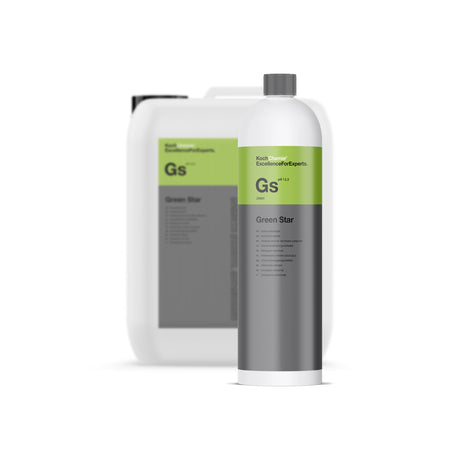
It starts with the Koch-Chemie Magic Wheel Cleaner "Mwc" Wheel Cleaner in the 500 ml spray bottle. It's acid-free with a pH of 5 to 6, and a red-violet colour change shows where it's dissolving iron particles. With a viscosity of 50 mPa·s it clings to vertical spokes instead of running off at once. Twenty verified reviews on Trusted Shops average 4.9 out of 5 stars. Its limit: it doesn't dissolve tar and bitumen, so you need a separate tar remover for those.
Add the Flex Brush for the wheel barrel, the Wheel & Engine Brush in 50 millimetres for the gap at the brake caliper, the SUPREME Wheel Brush for the wheel face and the Soft99 brush in 16 millimetres for the lug nut holes and valve. For the tyre sidewall, a simple firm hand brush that never touches a wheel is enough. You'll find more shapes and sizes in the Wheel brushes category.
The limits of this setup are clear: baked-on brake dust that has sat on the wheel for months won't come off with any brush alone. In that case the cleaner goes on the wheel twice, and which surface your wheel actually has decides which cleaner is right. We cover that in the article Cleaning alloy wheels: which finish you're actually dealing with. And since Monday looks dry, it's worth sorting your tools today: one bucket, four brushes, cleaner within reach.
Care decides how long they last. Rinse every brush with clear water straight after use until no grey haze runs out, squeeze out the microfibre head and let everything air-dry hanging. Splayed bristles, or grit that has settled in the fibre head, are your signal to replace. Cleaner that dries in the head makes the fibres hard, and a hard fibre is no longer a gentle one on the next wheel.

Jasper's day-to-day tip: Most of the wheel brush questions that reach us are about scratches, and almost always the same habit is behind them: one brush for everything, and the tyre gets done first. Flip the order, and give every brush its zone.
A strip of coloured tape on the handle of the tyre brush is enough to make sure it never ends up on a wheel by accident. And before the first contact with the wheel barrel, the microfibre gets two squirts of cleaner straight onto the head, so it glides instead of dragging.
No time for the whole post? Get it summarized: