


Tyre shine is a decision, not a product category
Two weeks after the wash that brownish haze is back on the sidewall. Most people reach for the next bottle of tyre shine and simply lay on more. That is exactly where it goes wrong, because the haze is not dirt. It comes out of the rubber itself, and a dressing over the top only hides it for a few days.
Tyre care splits into two camps that work in different ways. Water-based polymers sink into the sidewall and give you a satin black. Film-forming gels sit on top and deliver high gloss. Which camp suits you is decided before you buy.
A dressing does not colour the tyre, it fills it
A tyre dressing does not dye the rubber. It settles into the porous sidewall and brings back the blackness that ageing and cleaning have taken away. The tyre is deep black from the factory because carbon black sits in the compound as a filler. What makes it look grey is the roughened, micro-porous surface of the sidewall, which scatters light in every direction instead of reflecting it.
That is exactly where every care product goes to work. Fill the micro-pores and smooth the surface a little, and the tyre reads darker and richer without mirroring. Lay a closed, smooth film over the top and the sidewall reflects in one direction, so the tyre gains gloss. Both are surface physics, not pigment. That is why no tyre care keeps a tyre black forever — only for as long as its film stays on the sidewall.
The same distinction explains why one product looks completely different on two cars. On a two-year-old, properly cleaned tyre a thin polymer layer gives you an even deep black. On a tyre carrying old silicone residue and bloomed protective wax, that same film sits on an intermediate layer that is not even itself. The result goes patchy, and the dressing is not to blame — what was underneath is.
For the buying decision that means the question is not which product goes blackest. It is which surface finish you want, and how often you are willing to top it up. A satin finish forgives an uneven sidewall because it barely mirrors. A high-gloss film shows every irregularity underneath, because it lights it up with reflection.
The wash pulls at that layer too. Every shampoo and every wheel cleaner takes part of the surface protective waxes with it, and that is why a freshly washed tyre often looks greyer than the dirty one did before. That is not damage, it is the normal state of a clean sidewall. Tyre care gives that surface back visually what the cleaning removed, and lays a sacrificial layer over it for the next lot of road grime to work on instead of the rubber.
Satin comes from the polymer, gloss from the film
The difference between satin and high gloss sits in the chemistry, not in how much you lay down. Water-based polymer dispersions and film-forming gels build two different surfaces, and both routes are technically sound.
A water-based polymer like the one in GYEON Q²M TireExpress Reifenpflege works without silicone oil. The polymers bond with the rubber surface instead of sitting loose on top. What you see is a deep, quiet black with a light satin sheen, which the maker rates at three to four weeks. With no silicone oil in play, nothing slings onto the paint when you pull away — the very thing that leaves those brown streaks behind the arches with silicone-heavy shines.
A gel like Meguiars ULTIMATE "Insane Shine" Tire & Trim Gel Reifenpflege takes the other route. The thick consistency stays where you put it, keeps off the wheel and builds a closed gloss film. The label says "Durable Gloss Lasts up to 30+ Days" and promises outright that nothing runs, drips or slings. The same bottle also covers bumpers and arch liners, so it is more than a tyre product.
The honest read in between: satin looks unspectacular on day one. If you are after the wow effect you will find it underwhelming, especially on older, already-greyed tyres. Gloss delivers that effect straight away, but it wants cleaner prep and shows more clearly after ten days that it is fading. You know the same logic from the cabin, where we dress interior plastic satin rather than shiny for exactly this reason.
That leaves the question that sits at the top of every search engine: is tyre shine bad for the tyre? The honest answer splits by chemistry. Tyre makers such as Continental and Bridgestone warn explicitly against products with petroleum distillates and harsh solvents, because those pull plasticisers and antiozonants out of the rubber and make the sidewall brittle over time. Michelin goes further and simply recommends water and mild soap.
Water-based polymers and modern gels with UV blockers do not fall into that category — they sit on the rubber instead of dissolving into it.

The brown haze is blooming, not dirt
The yellow-brown film on neglected tyres is not road grime. It is antiozonant that the rubber sweats to the surface as its own UV and ozone protection. Those waxes are part of every tyre recipe. Over time they migrate outward, oxidise there and settle as a brown veil across the sidewall. The tyre is doing exactly what it was built to do — it just looks bad doing it.
The substance behind it has a name: 6PPD, the standard antiozonant of the tyre industry. It migrates continuously from the inside to the sidewall, catches airborne ozone before it can split the rubber chains, and oxidises into a yellow-brown compound in the process. So the brown veil is the proof that the protection is working.
Here is the odd part: that migration is kept going by flexing and heat. A car that stands for months blooms less and still ages faster, because nothing tops the surface up and ozone cracks start to form.
For tyre care this is the decisive point. A dressing laid over that layer does not grip the rubber, it grips the wax, and it comes off together with it. That is why tyre care lasts four weeks for one customer and four days for the next, even though both bought the same bottle. The difference is not in the bottle, it is in what was on the sidewall beforehand.
An alkaline tyre cleaner like GYEON Q²M TireCleaner Reifenreiniger runs at around pH 12 and splits two things at once: the bloomed wax layer, and the silicone-oil and wax content of old dressings. What is left is a residue-free sidewall where the new dressing actually sits on the rubber. Car shampoo will not do it, because surfactants get nowhere against migrated protective wax.
How you know the base is right: the cleaner turns yellow-brown as you brush it in, and that colouring gets weaker with every pass. Once the foam stays white under the brush and the sidewall dries evenly grey instead of patchy brown, the prep is done. Only from that point does the satin-or-gloss question make any sense.
Silicone oil makes that starting point measurably worse. Cheap shines put silicone oil on the sidewall where it neither soaks in nor bonds; it stays as a greasy film and gets flung against the bodywork when you pull away. On the paint that mist dries into a brown streak pattern behind the arch, and in the rubber a layer stays behind that stops the next application from reaching the compound at all. Switching away from silicone-heavy products calls for a deep clean, not a wash.
Clean until the cleaner stops colouring
The workflow is identical for both finishes right up to the last step: pre-clean the tyre, then the wheel, rinse both together, let everything dry fully and only then dress. The order is not a detail — it is the reason the result holds.
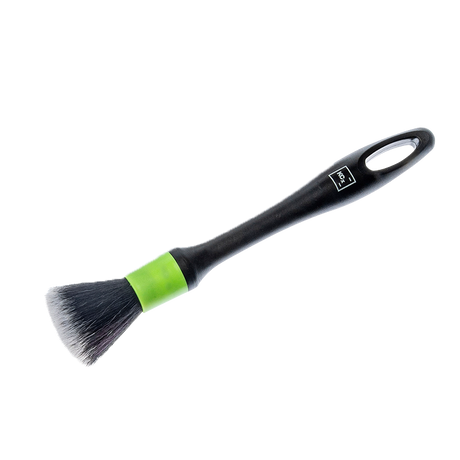
The tyre goes first, because wheel cleaner otherwise runs over the sidewall and neutralises part of the tyre cleaner's alkalinity. Spray it on, give it around 60 seconds, then work it into the grooves and lettering with a stiff brush such as the GYEON Q²M TireBrush Reifenbürste. On badly neglected tyres two or three passes are normal, and each pass colours up less than the one before. Work on hand-warm rubber and never in direct sun, or the product flashes off and leaves streaks.
Then drying decides — and this is where the two camps part company for the first time. A gel wants a bone-dry sidewall, because residual water lets the hydrophobic film slide past the rubber: the result goes cloudy and slings off on the first drive. A water-based emulsion tolerates residual moisture, because the leftover water bonds with the product and evaporates with it. If you want to keep working straight after the wash, the water-based route buys you time.
If you want the wheel side of the job cleanly separated, the surface question is in our piece on alloy wheels and their finishes.
For the application itself the same holds for both camps: thin, even, with an applicator rather than out of an aerosol. Two or three overlapping passes around the sidewall give a more even picture than one thick coat, because the material gets into the lettering and the grooves. Then let it flash off for at least ten to fifteen minutes before the car moves. That is the window in which a polymer film pulls in and a gel stops being sling-ready.
Working with gel adds one step most people skip: after roughly ten minutes, go over the sidewall once with a retired dry microfibre towel and take off the excess, especially out of the grooves in the lettering. That is not cosmetic finishing, it is the most effective protection against sling. The centrifugal force that throws material onto the paint grows with its mass — whatever does not stay on the sidewall becomes brown specks on your sill at 100 km/h.
One point belongs here explicitly, because it is a safety matter: tyre care goes on the sidewall, never on the tread. The tread is the contact patch to the road, and any film there changes exactly what is meant to brake and steer the car. With gel that is barely an issue thanks to the thick consistency; with thin sprays it happens fast. If you spray, keep the nozzle flat to the sidewall and wipe any overspray straight off.

Four bottles off our shelf, two routes
Four products from the range cover both routes cleanly, and three of them belong to the same job. Prep, finish, tool — the sidewall needs nothing more.
The prep is handled by GYEON Q²M TireCleaner Reifenreiniger. Alkaline at around pH 12, made for black rubber in every form, summer, winter or all-season. What it is not made for is whitewall tyres and painted wheels sitting directly in the spray path. Mask those or rinse them straight away, because the alkalinity does not tell the difference between a rubber sidewall and clear coat.
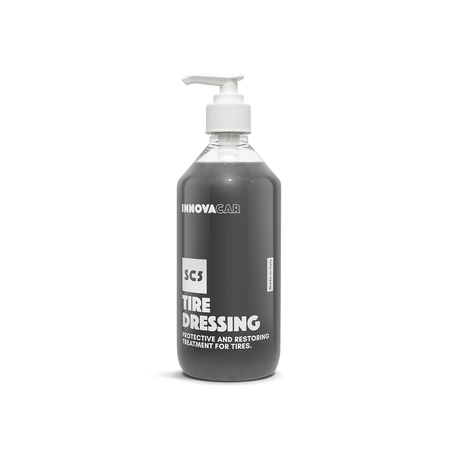
For the satin route there is GYEON Q²M TireExpress Reifenpflege, water-based, silicone-free, with a pump head for dosing onto the applicator. Three to four weeks of quiet black, no slinging onto the paint, and in exchange no mirror effect on day one.
If you want gloss, take Meguiars ULTIMATE "Insane Shine" Tire & Trim Gel Reifenpflege, which does the same job on faded exterior plastic. As a second gloss option, Meguiars GOLD CLASS Endurance Tire Gel Reifenpflege works with macropolymers that the rubber absorbs rather than merely carrying. Meguiar's rates that at seven to ten days of visible gloss, then you top it up.
The tool decides how even it goes on. The GYEON Q²M TireApplicator Reifenapplikator is an open-cell foam block with a smooth top face that you steer between thumb and fingers, without product running onto your hand. An applicator doses far more sparingly than any spray bottle, and it puts the material exactly where it belongs: on the sidewall, not on the tread. You will find all four together in the tyre care category.
On quantities, since we get asked: what we see day-to-day is that a 500 ml bottle laid on thinly covers roughly 20 to 30 full sets of wheels, so a good season at fortnightly intervals. If you regularly do several cars, the 1000 ml version works out cheaper with no change to the product. An applicator lasts several months if you store it clean — hardened product on the foam edge is the signal to swap it, because a clogged block only smears instead of spreading.
Quiet picks satin, presence picks the gel
The decision comes down to three questions: how often you drive, how often you top up, and how the car should read in the car park.
If you drive daily, wash every two to three weeks and want peace afterwards, satin is the fit. The polymer film survives rain and several washes, the result ages evenly instead of patchy, and there are no silicone specks on freshly sealed paint.
If instead you work at the weekend, prepping the car for photos, a meet or a sale, and the effect has to sit the same day, you go for the gel and take the shorter life on purpose.
Two special cases, because they land with us regularly. Tyre pressure sensors sit inside on the wheel and never touch a dressing on the outer sidewall — the worry is unfounded as long as you keep the spray out of the barrel. And rubber in the cabin, meaning floor mats and pedal rubbers, is explicitly not part of this scheme: there you want a silicone-free, non-slip care product, because a smooth film under your shoe turns into a safety problem.
On timing, the weather helps you this week. It stays dry through Thursday at 25 to 29 degrees, with rain from Friday. Clean and dress the tyres now and you give the film the dry window to cure, going into the wet half of the week with a closed layer. Start on Saturday instead and you are working on damp rubber, then wondering about the clouding. More for wheels and tyres sits in Reifen & Felgen.
And a word on the automatic car wash, because it usually gets left out of the maths. The brushes and the alkaline pre-wash of a rollover strip any dressing faster than rain ever could. If you mostly wash in a machine, halve the quoted durability of both camps in your head and plan the dressing right after the wash rather than treating it as a monthly ritual. That is no weakness of the products, just the reality of mechanical cleaning.

Detailing1-Insight: The most common mistake is the second coat on the same day. The tyre does not look rich enough after the first thin pass, so more material goes straight on — and by the next morning there is a greasy film on the sidewall that grabs dust and lands as a smear on your sill in the first rain. Give the coat fifteen minutes; a polymer film keeps pulling in. If depth is still missing after 24 hours, the second thin coat is right — straight afterwards it almost never is. On one of our test cars that impatience cost us a full re-clean two days later.
No time for the whole post? Get it summarized: