



Pollen, tree sap and a thunderstorm hit the paint on the same afternoon
It's 25°C, the paint is warm, and the whole of May is sitting on your bonnet at once: a yellow film of pollen, two or three sticky blobs of tree sap, the first bug splatter across the front end. Getting pollen and tree sap off without scratching the paint isn't one wipe — it's a question of order. Most people reach for a cloth and wipe the lot in one go, and that single wipe is exactly the mistake that comes back weeks later as a fine web of swirls in the sun.
Pollen, tree sap and bug splatter are three different kinds of dirt with three different chemistries, and they need three different steps in a fixed order. Get the order right and you clear warm paint scratch-free, before the next storm turns that loose dust into a baked-on layer.
Why warm paint starts the clock
Clear coat isn't a rigid shell — it's a polymer layer that goes softer and slightly more open-pored in the heat. At today's 25°C, on a car that's been sitting in the sun, that layer works against you: anything acidic soaks in faster. Tree sap carries organic acids; so do bug splatter and bird droppings.
On cool paint, you've got days. On warm paint, that window shrinks to about 48 hours. After that the edges etch into the clear coat as dull halos, and no wash pulls those back out — from there on only polishing helps, and that removes material. So the difference between a dissolved droplet and an etched halo isn't down to the product, it's down to the hours.
Today a second hand joins the clock. The German weather service has put out an early warning for a severe storm this afternoon: gusts up to 85 km/h, heavy rain around 25 litres per square metre, hail in places. For dust-covered paint, none of that is good news. The rain won't wash the pollen off — it glues it into a stubborn film.
If the sun comes back out after the shower, the mineral-heavy water bakes water spots in on top of everything, because on warm paint the droplets evaporate in minutes instead of running off. At 51% humidity and full May sun, a puddle dries before you've fetched the bucket. If you want to dig deeper into the 48-hour idea, we lay it out in full using those first bugs as the example in this post.
What we see day-to-day is that the typical bit of damage isn't the fat sap blob everyone spots — it's the thin veil of pollen everyone writes off as harmless. It feels like dust, but it's made of tiny, hard grains. Wipe it dry and every one of those grains acts like a piece of sandpaper you're dragging across the paint yourself.
Step one is touch-free: pollen is a layer of dust
The first step never touches the paint at all. Pollen is a loose, mineral-hard layer of dust, and the only safe way to get it off warm paint is a touch-free pre-wash. You spray on a pH-neutral cleaning foam like the Gentle Snow Foam, let it soak the film loose, and rinse it away grains and all — before a cloth or mitt ever comes into play.

The foam is deliberately kept pH-neutral for a practical reason: it works every day, and on a fresh sealant too, without attacking the protective film. An alkaline cleaner would take a bit of the coating with it on every pass — and for loose pollen that's only sitting on top anyway, that's using a sledgehammer to crack a nut.
One detail that tends to slip when you're in a rush: the foam needs a few minutes of dwell time, but it mustn't dry on warm paint. Better to park in the shade, work panel by panel and rinse early. That the product does more than just cars is something we hear from customers all the time — some have used it for years on the motorbike or the inflatable boat too, anywhere loose dirt shouldn't get rubbed in.
Only once the pollen is rinsed off does the actual hand wash follow, with two buckets — one for the wash solution, one to rinse the mitt. Put a cloth to the paint before that and you're dragging the grains across it. That's the point where the invisible scratches are born — the ones nobody notices during the wash and everybody spots two weeks later in the sun.
Bug splatter and bird droppings: the protein problem
Bug splatter and bird droppings aren't dust — they're dried-on protein with acidic content, and they don't come off under pressure, they come off by soaking. One of the most common questions that reaches us over chat is simply: “Can it remove bird droppings effectively?” The honest answer: yes, but only if you soften it up rather than rub it off.
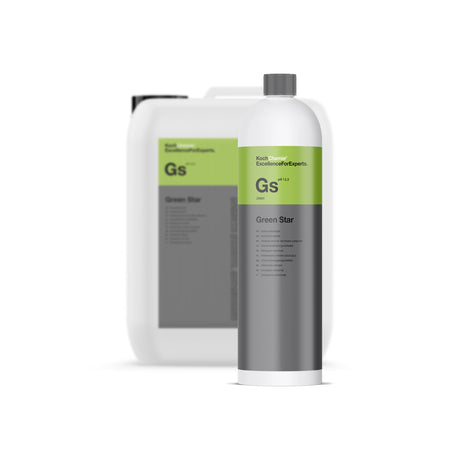
Rub it dry and you're dragging the mineral bits across the paint like grit — and bird droppings in particular carry fine, hard particles that turn any dry rub into a sanding motion. This is where an all-purpose cleaner like the Green Star comes in, one of our best-selling cleaners. Spray it on diluted, let it soak for one to two minutes, and the dirt lets go almost on its own — all that's left is to lift it off with a soft cloth.
For a front end covered in bugs, work generously and give the chemistry time. The dilution controls how hard the cleaner bites: a mild mix around 1:10 for everyday, a stronger one for the baked-on bumper after a motorway run. If you want to know when the all-purpose cleaner is enough and when a dedicated bug remover makes more sense, sort that out before you spray, not halfway through.
What we won't promise: that a cleaner brings back an edge that's already etched. Once bird droppings have sat for two hot days, you're often left with a dull patch only polishing can reach. That's exactly why the soaking comes at the start of the day and not the end — the clean spot today is the etched shadow you save yourself at the weekend.
Removing tree sap means dissolving it, not scraping
Tree sap is the stickiest of the three, and also the one where most paint damage comes from sheer impatience. Try to get tree sap off and you notice fast: water and microfibre aren't enough, the blob won't wipe away, and a fingernail or a plastic card leaves a mark in the soft, warm clear coat right away.
Sap gets dissolved, not scraped off. You put a dedicated pre-cleaner for tar and sap on a cloth, hold it on the blob for a few seconds, and it softens the bond from the outside until it lifts away without any pressure. The fresher the blob, the shorter the dwell time — a spot of sap from this morning gives up after a few seconds, one from last week takes several goes.

If a slight residue you can feel or a shadow stays behind after dissolving, that's a job for the clay bar, not for more force. A Clay-Spray as a lubricant together with a clay bar picks up the last bonded particles without stressing the clear coat. The order matters here too: dissolve first, then clay, never go over the spot dry.
Just how deep the sap topic goes, and why fresh blobs are so much easier than old ones, we broke down in our tree sap post. The common thread across all three kinds of dirt stays the same: each has its own tool, and none of them is brute force. In detailing, your hand is almost always the crudest tool in the bucket.
The order, and drying before the storm
Now it all comes together. The order on a warm day with a storm rolling in isn't random: touch-free pre-wash for the pollen first, then soak the bugs and bird droppings, then dissolve the tree sap, then the actual hand wash, and drying last. Swap the steps around halfway through and you either rub dust in or smear dissolved sap across half the door.
The reason for exactly this sequence is simple: each step removes the dirt that would get in the way of the next. Leave the pollen on and it ends up in your cloth while you soak the bugs. Don't dissolve the sap before the wash and it smears across the panel as you go. The order isn't a ritual — it's the logic that stops one step from undoing the one before it.
Daniel, Detailing1: “When the storm's an hour out and I can't get everything done, I make a clear call. Rinsing off the pollen and roughly de-bugging the front end takes priority, because that's the dirt the rain bakes in. The tree sap, on the other hand, can wait until tomorrow if it has to, as long as it's not sitting in blazing sun.
And instead of chasing it with an ordinary cloth, I go over the wet car with the Finish Spray — it drives the water off and heads off the water spots the heavy rain would leave. Better three panels done right than the whole car rushed and wrong.”
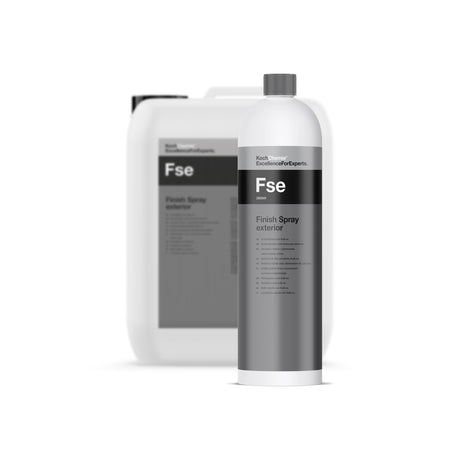
When it comes to drying, a product that does two jobs at once pays off. The Finish Spray Exterior with Kalk-EX is meant as a quick detailer that works on wet paint as a drying aid, makes the water bead off, and binds exactly the water spots the mineral-heavy storm water would otherwise leave behind.
It's no substitute for a sealant, but it bridges the afternoon when things have to move fast, and gives the paint a light protective film for the next few days. That it's been a fixture in a lot of routines for years is something we hear often — a loyal crowd that just won't put it down, because wash and light protection fall into one step.
Drying itself decides scratches too. Dragging a wet microfibre cloth across the paint pushes leftover particles ahead of it and draws fine lines. Better to blot: lay the cloth down, let it take up the water, lift it, set it down fresh — instead of wiping.
On a panel that's had a touch-free pre-wash there's barely any dirt left that could do damage while drying anyway — which is why the first step of the day was the most important one. If you're really pushed for time because the storm's already rumbling, cover the big horizontal panels with the quick detailer and the blotting technique, and leave the vertical rest to the running water.

Sealant: why the next layer of pollen just slides off
The last thought is the most important one for the rest of the season: an intact sealant turns the whole procedure above into a relaxed ten-minute job. On a sealed surface neither pollen nor sap gets a proper grip. The dirt sits on top instead of anchoring in, and the next touch-free pre-wash already rinses most of it away.
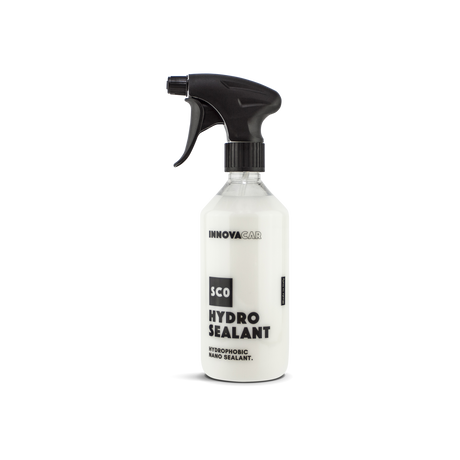
A paint sealant that lasts twelve months isn't a luxury, then — it's the shortcut through the whole pollen and sap season. It pays off not in gloss but in time: every wash that gets shorter, and every droplet that no longer soaks into the clear coat, is saved effort and saved risk across the whole warm half of the year.
Still, the honest limit, so nobody gets the wrong idea: a sealant doesn't keep tree sap away. It buys you time and makes the later dissolving easier, because the sap isn't stuck straight to bare clear coat. It doesn't stop the 48-hour hand — it only slows it down. If you want to know which protection suits your paint and your effort, you'll find the range from the quick layer to the long-life sealant in our categories paint sealant and spray sealant.
In the end it's not the priciest product that decides how the paint fares, it's the order and the timing. Three kinds of dirt, three steps, one warm afternoon with a storm at your back — start touch-free, soak instead of rub, and dry before the rain, and you bring your paint through the day clean and scratch-free. And with a good sealant you lay the groundwork for the next wave of pollen to simply slide off.
No time for the whole post? Get it summarized: