Leather Steering Wheel Restoration: Recolour Worn Spots
Jasper von Detailing1 |


Autumn tarmac leaves a film on the paint. Foam lifts it without contact.

Koch-Chemie
Pump sprayer with 1:1 to 1:10 scale for interior concentrates
iK Sprayers
"iK Foam" Pro 2+ (Plus) Pump Foam Sprayer with Compressor Valve (incl. Colour Coding)
Professional pump foam sprayer for versatile cleaning tasks
iK Sprayers
"iK Foam" Pro 2 Pump Foam Sprayer (incl. colour coding)
Professional foam sprayer for versatile car care
solo
solo CLEANLine "VARIOfoam" (304 FA / FB) — 2 Litre Foam Sprayer
2-liter foamer with infinitely adjustable VARIOfoam foam adjustment
iK Sprayers
"iK Foam" 1.5 Pump Foam Sprayer
Professional Foam Sprayer for Car Care
Snow foams for lance and pressure sprayer.


Kränzle
Replacement Container for "Foam Lance"
Easy organization of cleaning foam


Kränzle
Screw Cap for "Foam Lance Spare Container"
Screw cap for secure and practical storage
iK Sprayers
"iK Foam" Pro 12 pump foam sprayer with compressor valve
High-Quality Foam Sprayer for Professional Detailers


Kränzle
Kränzle Foam Lance with Bottle for "D10/D12"
Adjustable spray angle with high-quality container for snow foam


iK Sprayers
"iK Foam" Pro 2 Alk Foam Sprayer (Alkaline)
Alkaline foam for professional pre-wash


bigboi
Perfect vehicle cleaning with innovative foam technology
solo
CLEANLine "VARIOfoam" (333 FA) 4-Litre Foam Sprayer with Coiled Hose
Large foam sprayer with varioFOAM, hose, and lance
How does a foam sprayer make foam without high pressure? A hand pump builds pressure in the tank and forces the ready-mixed solution together with air through a fine mesh. At Detailing1 you'll find hand foamers, pump-pressure units and battery-powered models from iK Sprayers, solo, Koch-Chemie and SONAX.
Foam sprayers are pressure sprayers that whip a ready-mixed cleaning solution into foam with air instead of atomising it into a mist. The pressure comes from a hand pump or a battery compressor, not from a pressure washer. At the outlet sits a foam head with one or two fine meshes. Liquid and air are forced through the fabric together and leave the nozzle as dense foam that clings to vertical surfaces.
Detailing1's tip from the shop: We regularly get questions about foam that sticks thick to the glass and barely rinses off. Almost always there's one cause behind it: the foam lance recipe was carried over one-to-one into the foam sprayer. In the lance, the water flow mixes the concentrate once more, whereas the tank already holds the finished solution. So work from the cleaner's in-use dilution, not from the lance mix. And run clean water through the foam head after every use, otherwise residue dries in the mesh and the foam comes out thin next time.
Here, foam isn't created by pressure alone but by shear. Liquid and air are squeezed together through a tight fabric and break up into bubbles as they pass.
The tank is a small pressure vessel. With the pump piston you push air in until there's a cushion of about three bar above the liquid. That cushion is the drive. It pushes the solution through the dip tube, the hose and finally into the foam head.
The foam head is where the real tech sits. A constriction speeds up the jet, it draws in air through side openings, and that mix hits one or two meshes of fine fabric. As it passes through, the mesh tears the liquid film into countless tiny bubbles.
Mesh size determines what the foam looks like. A tight weave creates small, even bubbles and so a creamy consistency that holds for a long time. A coarse weave delivers lots of volume quickly, which collapses faster. What that means for you: density beats quantity, because only foam that stays put gives you contact time.
Without the right chemistry, even the best nozzle won't help. Foam needs surfactants, meaning cleaning molecules with a water-loving and a grease-loving end. They settle into the bubble wall and stabilise it. So a degreasing cleaner without a foaming agent stays liquid even in a foam sprayer.
Wet or dry is a matter of setting. Lots of air in the mix gives a dry, shaving-foam-like layer that clings for a long time and needs more water to rinse off. Less air gives wet foam that runs off slowly and takes the loosened dirt with it. For pre-treating paint, the wetter foam is usually the smarter compromise.
The water has a say too. Limescale binds part of the surfactants, so in hard tap water the foam comes out visibly leaner. Lukewarm water at around thirty degrees dissolves the concentrate better and noticeably improves foam quality. Any hotter isn't allowed because of the seals.
Both make foam. But they draw their energy from completely different places, and everything else follows from that.
The foam lance hangs on the pressure washer and lives off its water flow. The jet pulls concentrate from the reservoir through a constriction and pushes the mix through a mesh. Without pump, power and water supply, nothing happens.
The foam sprayer carries its energy with it. The tank is both reservoir and pressure source, and the air comes from the hand pump or a small compressor. That lets you work on a street parking spot, under the carport, on a multi-storey car park or at the motorhome.
The difference shows in consumption. A lance pushes many litres of water over the car in two minutes of pre-wash. Two litres of ready solution in the tank cover the same area. If you're working with canister and bucket instead of a mains connection, you notice straight away.
The foam sprayer still has limits, and we'll tell you upfront. It applies and softens, it doesn't rinse anything away. With salt and grit in winter, the pressure washer remains the tool that blasts off the heavy dirt before a towel ever touches the car.
Then there's a point many only come to appreciate after buying. A foam sprayer is quiet. No pump running in the yard, no cable across the pavement, no debate with the neighbours on a Sunday morning. Set-up time is twenty strokes on the pump handle.
In practice the two complement each other. If you have a pressure washer, use it for the full-coverage Snow Foam pre-wash and the foam sprayer for anything targeted: wheel arches, door sills, the bug-splattered front, wheels. If you don't have one, you can still do the whole round with the sprayer.
Three designs share this category. They differ mainly in how the pressure is created and how long it holds without re-pumping.
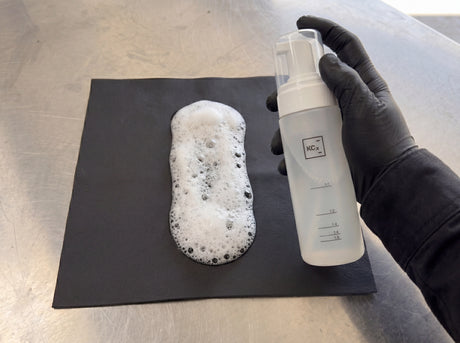
The hand foamer does without a tank. With every stroke, a pump head pushes liquid and air together through two small meshes. The Koch-Chemie Foamer Bottle belongs to this group and is at home in the interior, on upholstery, leather and plastic.
Pump-pressure units are the heart of the category. The iK Sprayers „iK Foam" Pro 2 Pump Foam Sprayer (incl. colour coding) and the solo solo CLEANLine „VARIOfoam" (304 FA / FB) — 2 Litre Foam Sprayer each hold two litres and cover a car in one go.
Not every unit makes only foam. The VARIOfoam series from solo can be switched at the head from wet foam to a spray jet, and the SONAX PROFILINE PowerFoamer Foam Atomiser also works with pump pressure from the tank. So one unit does two jobs.
As the area gets bigger, the tank grows with it. The iK Sprayers „iK Foam" Pro 12 pump foam sprayer with compressor valve takes much more solution and can also be filled with compressed air via its valve, instead of being pumped up by hand.
The number in the model name refers to tank volume, not fill quantity. There has to be room for an air cushion above the liquid, otherwise no pressure can build. Count on about a third less usable solution with every model, and the fill mark on the tank stays what it's meant to be: a limit, not a recommendation.
The third design takes the pumping off your hands entirely. A battery compressor keeps the pressure constant, the foam comes out of the nozzle evenly and doesn't drop off when the tank is half empty. With several cars in a row, that's the most noticeable gain.
A foam sprayer is a tank with seals and valves. Both have to suit the chemistry you fill it with.
Alkaline pre-cleaners attack standard seals. That's why some series come in two versions. The iK Sprayers „iK Foam" Pro 12 Alk Foam Sprayer (Alkaline) has seals designed for alkaline concentrates. If you regularly work with pre-cleaners, go for this version.
Coloured marker rings solve a second problem. As soon as two or three units stand side by side, you can't tell from the outside what's in them. The colour coding on the iK Foam Pro 2 turns a memory test into a quick glance. A mix-up here costs paint or seals.
For dilution, work from the in-use solution, not from the wash water and not from the lance. For pre-treatment, a cleaner in the foam sprayer is mixed stronger than in the bucket, because it's meant to soak, not glide. The manufacturer's value on the label is your starting point.
After use, release the pressure and rinse out the tank. Alkaline residue crystallises as it dries, and the fine mesh in the foam head is the first place that shows. Two minutes of clean water through the unit saves you taking the nozzle apart.
Over winter, store the unit empty and depressurised. If solution is left standing, seals swell and springs start to corrode. A drop of silicone grease on the O-rings of the pump rod keeps the piston running smoothly. We often see that a seal kit is then enough instead of a new unit.
The biggest advantage shows where no water comes out of the wall. Street parking, carport, multi-storey car park, motorhome at the campsite.
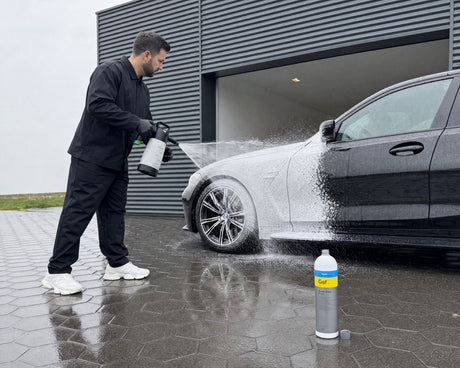
The routine stays the same as with a pressure washer. Pre-wet the car, apply foam from bottom to top, let it soak for three to five minutes and then wash with two buckets. Bottom to top because run-off streaks on dry paint would otherwise leave marks.
Targeted work is the second strength. Wheel arches, door sills, sills, the bug-splattered front and the area behind the wheels get foam precisely and in the amount they need. At these spots, a pressure washer jet mainly sprays water all over the surroundings.
Inside the car, foam works dry enough not to soak the upholstery. A fabric cleaner stays on the fibre as foam instead of soaking into the padding underneath, and can be worked in with a brush and taken off again. On leather the same principle applies with less pressure.
Wheels are the third classic. Foam clings to the spokes instead of running straight down into the barrel, and you can see exactly which area is already wetted. For coated alloy wheels, a neutral cleaner does the job. Acidic products don't belong in a standard unit.
In winter the picture shifts. At temperatures around freezing, foam freezes onto cold panels instead of soaking, and the leftover water in the hose bursts the seal as it freezes through. So fill it lukewarm, work quickly and afterwards store the unit empty and frost-free.
And there's consumption. Washing with two litres of foam and two buckets gets you by with far less water than any round with a running hose. At many parking spots, that's exactly the condition under which you're allowed to wash at all.
The choice comes down to three questions. How big is the area, how often do you wash, and what chemistry goes in?
For interior, leather and small areas, a hand foamer is enough. The Koch-Chemie Foamer Bottle needs no pressure build-up, sits ready on the shelf and is filled in ten seconds. For exterior washing it's too small, and that's not its job anyway.
A compact or mid-size car you can handle with two litres. The iK Sprayers „iK Foam" Pro 2 Pump Foam Sprayer (incl. colour coding) is our best-selling pump-pressure unit, the solo solo CLEANLine „VARIOfoam" (304 FA / FB) — 2 Litre Foam Sprayer the pick if you want to switch spray patterns.
If you prefer to keep your kit within one brand, the SONAX PROFILINE PowerFoamer Foam Atomiser is in the same class. Larger areas and several cars in a row, on the other hand, point to the iK Sprayers „iK Foam" Pro 12 pump foam sprayer with compressor valve.
If alkaline pre-cleaner is firmly in the plan, go straight for the right version. The iK Sprayers „iK Foam" Pro 12 Alk Foam Sprayer (Alkaline) saves you the seal kit a standard unit needs after a few months of harsh chemistry.
Not every job needs foam. For quick detailer and anything applied as a fine mist, a spray bottle is the better tool, and for cleaners in a solid jet a pressure pump atomizer. All designs side by side are under Spraying & foaming.
And when you move from the unit to the chemistry: shampoos, pre-cleaners and concentrates are under car wash, the high-foaming pre-wash products under Snow Foam. The foam sprayer is the tool that turns both into a wash without a water connection.
Too much choice in Foam Sprayer? Get help picking:
Jasper von Detailing1 |

Daniel von Detailing1 |

Daniel von Detailing1 |

Daniel von Detailing1 |

Jasper von Detailing1 |

Jasper von Detailing1 |

Daniel von Detailing1 |

Daniel von Detailing1 |

Daniel von Detailing1 |

Daniel von Detailing1 |

Daniel von Detailing1 |

Daniel von Detailing1 |