

More GSM does not make your microfibre cloth better
On one of our product pages the figure was right there in the name, and the question still came in: “What GSM does this microfibre cloth have?” That is not a misread. The customer wanted to know what to do with the number. And that is exactly the problem: GSM is printed on almost every label, but hardly anyone explains what the value stands for and which value belongs to which step of the job.
GSM is the weight of a cloth per unit area, in grams per square metre. The value says how much fibre material is available, not how good the cloth is. Only together with pile type and edge does it show what the cloth is good for.
GSM is a weight, not a quality grade
GSM stands for grams per square metre. A cloth with 500 GSM weighs 500 grams over exactly one square metre. The number says nothing beyond that, and above all it says nothing about quality.
What makes a cloth microfibre in the first place is the fineness of the yarn. The definition starts below 1.0 denier; in detailing the good fibres work between 0.1 and 0.5 denier. For comparison: a human hair measures 60 to 80 micrometres, the fibre in the cloth is around a hundred times finer. In production a continuous filament is split lengthwise, so one filament becomes dozens of wedge-shaped single fibres.
These split edges are the actual working mechanism. They shovel residue upwards into the pile instead of pushing it across the clear coat. You notice it like this: the paint gets cleaner on the second pass instead of smearier. A cloth without split fibre does the opposite, no matter how heavy it is.
The second variable is the blend ratio. Polyester provides structure and service life, polyamide makes the cloth soft and absorbent and costs more to produce. That is why the figure on the packaging is a decision, not a side note. The Koch-Chemie Pro Drying Towel 950GSM runs 70 to 30, the Dr. Wack A1 "DAS TUCH" 85 to 15.
Absorbency can be calculated from weight and area, and that is what makes the number useful in the first place. A good split fibre binds seven to ten times its dry weight in water. A microfibre cloth measuring 40 by 40 centimetres at 300 GSM weighs 48 grams dry and therefore holds around 336 millilitres. That sounds like little, but for its purpose it is exactly right.
Short pile, plush and Twisted Loop work differently
The pile architecture decides whether a cloth removes, cushions or absorbs. Weight alone decides nothing at all; it only limits how much material is there for the job.
Between 200 and 350 GSM is the range with bite. Short-pile, tightly closed weave has enough friction to separate solvents and resins cleanly from the surface. That is exactly what a fresh ceramic coating needs when the residue comes off.
Reach for the fluffy plush cloth here and the long fibres roll over the tacky layer and smear it instead of levelling it. The result is streaks that later come off only with a machine. Professionals therefore reckon on four to six fresh short-pile cloths per vehicle for a coating.
From 350 to 600 GSM the logic turns around. When wax, spray sealant or polish residue is removed, hard residue has to come off the paint and deep into the cloth. The long fibres work as a shock absorber: they pick up the particles and hold them several millimetres away from the contact face. A short-pile cloth would have too little volume here and would drag the residue across the panel.
From 800 GSM upwards it is only about volume, and that is where Twisted Loop plays its part. The fibres are not cut open but twisted into dense spirals that stand upright on the base weave. Lay a cloth like that flat on wet paint and thousands of capillary channels form and pull the water in. The cloth does not grip, it glides on a film of water.
Waffle weave is the special case in between, and the reason glass is a category of its own. The raised sections physically break up the greasy film on the inside of the glass, the recesses take up the dissolved dirt and the remaining liquid. Long-pile cloths manage neither: they lint on statically charged glass and glide straight over the film.

The edge scratches, not the pile
The most common source of scratches on a cloth is not the face but the border. That is where the hardest material sits, and that is where most of the pressure is transferred while wiping.
An overlocked edge is densely stitched with polyester thread and lasts forever. On paint, though, that raised bead of thread acts like a rigid squeegee. A speck of grit the wash left behind catches in the seam and is dragged across the clear coat under pressure. On dark paint you see the result at the next low sun.
The satin border is much softer, but it has a different catch. The tape takes up no water, so a streak is left at every point where the wiping motion reverses. That shows up precisely when drying and on glass.
The third construction solves both. With an ultrasonic cut, a high-frequency vibrating blade separates the weave and fuses polyester and polyamide at the border into a fine barrier. No perceptible bead forms, the cloth lies flat. The THE COLLECTION "Allround / Coating 300" is built that way, and the Dr. Wack A1 "DAS TUCH" is too.
How durable that edge is shows in the Koch-Chemie Polish and Sealing Towel 520GSM: according to the manufacturer it does not fray even after 50 machine washes. That is the point at which edgeless stops being a comfort feature and becomes a question of service life.
That does not mean overlocked cloths belong in the bin. They are the right choice for door shuts, exhaust tips, the engine bay and deep wheel barrels, so anywhere no sensitive clear coat is involved. They just have no place on painted outer panels any more, now that the edgeless version exists.
When drying, the too-light cloth makes the swirls
Drying is the step with the highest scratch risk in the whole wash. And the cause is almost always the same: a cloth that was too light for the amount of water.
The mechanism is unspectacular, which is what makes it so treacherous. A thin all-purpose cloth at 400 GSM is saturated after half a bonnet. Once the fibre is full of water, the pile collapses and loses its cushioning.
Keep pulling the soaking cloth along under pressure now and you rub the hard base weave straight across the soft clear coat. The result is fine, parallel marks that show up in direct sunlight even though the wash itself ran cleanly. Anyone looking for the mistake usually looks at the wash mitt and overlooks the cloth.
Run the numbers. The THE COLLECTION "Aqua" Twisted Loop Trockentuch (1500 GSM) and the Koch-Chemie Pro Drying Towel 950GSM in 50 by 80 centimetres carry 380 grams of their own weight and therefore bind a good 2.6 litres on paper. A 400 GSM cloth in 40 by 40 does not manage 450 millilitres on the same maths.
The technique for this is called blotting and gliding. The cloth is laid flat and pulled across the panel by two corners; the weight of the saturated cloth is all the contact pressure you need. Press on top of that and you compress the pile, cancelling out exactly the cushion you just paid for.
On freshly sealed vehicles it runs easier still, because the water sheets off on its own and less is left standing. How that works out across a whole vehicle is covered in detail in the article Drying your car without scratches.

Our cloths cover 230 to 1500 GSM
The spread in the range is no accident, it maps the steps of the job. Glass sits at the bottom end, drying at the top, everything else in between.
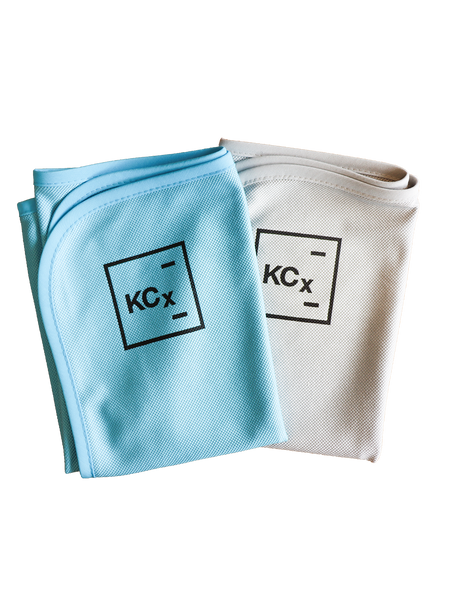
For windows the Koch-Chemie Pro Glass Towel 230GSM leads the list: 60 by 40 centimetres, very fine structure, in a set of two. Little pile is the intention here. The GYEON Q²M GlassWipe EVO at 390 GSM goes the same way via its waffle structure.
The middle ground is held by the edgeless all-rounders. THE COLLECTION "Allround / Coating 300" in 40 by 40 with a 70 to 30 blend is our best-selling microfibre cloth in this class and covers coating removal, interior and glass as well. If you want more reserve, reach for THE COLLECTION "Allround 365".
For removing polish residue and wax, the Dr. Wack A1 "DAS TUCH" with high pile on both sides is the right call. The manufacturer states up to 300 wash cycles, and the 85 to 15 ratio is no cost-saving move there but a deliberately different design. The softness comes from the pile length instead of the polyamide content.
The drying towels sit at the top. THE COLLECTION "Aqua" Twisted Loop Trockentuch (1500 GSM) and the Koch-Chemie Pro Drying Towel 950GSM at 70 to 30 are built for pure water uptake. The same logic applies to the wash mitt: the Koch-Chemie Exterior Wash Mitt 640GSM buffers grains of sand in the pile before they reach the paint.
If you want to see the whole range side by side, you will find it in our microfibre cloths and the drying towels. Which cloth makes sense for dried-on tree sap or pollen is covered in the article Removing pollen and tree sap without scratches.
There is no one cloth for everything
In the end the allocation is simple, once you read it as if-then sentences. It follows the task, not the price bracket.
If you are removing a ceramic coating or a wax, take a short-pile cloth between 245 and 300 GSM and fold consistently onto a fresh side as soon as it turns tacky. If you are buffing off polish or spray sealant, reach for high pile from 350 GSM. If you are drying, take Twisted Loop from 950 GSM and blot instead of wiping.
If you are doing the windows, take the glass cloth, and only the glass cloth. And if you want to get into the wheel barrel, no cloth helps at all, but the THE COLLECTION "Flex Brush" does, with its soft sleeve and flexible core.
Care decides how long that allocation holds up at all. Wash at 40 to 60 degrees and only with liquid microfibre detergent. Above 60 degrees the hair-fine fibres start to bond together, and the cloth turns hard and scratchy.
Fabric softener lays a water-repellent layer around the capillaries, and after that the cloth only smears. Powder leaves undissolved water softeners in the pile that act like fine sandpaper on the next pass. The tumble dryer, by contrast, is allowed, on a gentle cycle, because the tumbling motion raises the pile again.
Wash glass cloths separately as well. If a glass cloth runs in the same cycle as a wax cloth, it picks up the residue from the wash water and pulls a milky film across the pane the next time you clean the windows. The mistake only shows with the sun low, so exactly when it gets in the way.
One last rule that is in every forum and still broken daily: a cloth that has fallen on the floor does not go back on the paint. The static charge of the fibre binds sand and micro-grit so deep in the pile that even 60 degrees will not reliably rinse it out. Cloths like that move to the exhaust tips, not back onto the stack.
From Sunday the first dry window in days is due. Sort the stack today and get the wash running now, and at the weekend you will have the right cloth to hand instead of searching for it at a wet car.

Detailing1 insight: From our own practice, almost every query about streaks after a coating comes back to the same cloth that was used to take off wax beforehand. Sort your stack by task instead of by cleanliness, easiest by colour: one for removal, one for glass, one for drying. And read the blend ratio, not just the GSM figure. 70 to 30 means more polyamide, more absorbency, a higher price. Once you have understood that, you never again buy the cloth with the biggest number on the bag.
No time for the whole post? Get it summarized:
Add Detailing1 as a preferred source on Google