

Spring cleaning: How to properly free your car from winter grime
What actually happens to your paintwork after it has been exposed to road salt, brake dust, industrial fallout, and moisture for months? In short: It suffers. When frozen, road salt is relatively harmless — it simply sits on the surface. But as soon as temperatures rise above 4 °C, the layer of salt becomes an active electrolyte solution that attacks the clear coat and unprotected metal surfaces. That is exactly what is happening now: the forecast shows temperatures of 12 to 18 °C for the coming days. The perfect moment for the most important wash of the year — the spring wash.

Why the spring wash is no ordinary wash
A typical car wash removes the dirt from the last week. The spring wash, on the other hand, eliminates everything that has become ingrained over months — and that is more than you see at first glance. Beneath the visible film of dirt lies a layer of industrial fallout, mineral deposits, and tar residues that have worked their way into the clear coat during the cold season. Experts call this contamination: foreign particles that are no longer sitting on the paint, but are stuck in it. You can tell if your paint is contaminated if you run your hand over a washed hood and it feels rough — even though it looks clean.
On top of that, the season's first pollen is already on the move. Alder, hazel, and ash are flying in full intensity, and the birch is waiting in the wings. Pollen on warm paint produces enzymes that attack the clear coat within 24 to 48 hours — so-called pollen etching, which appears as matte spots. Those who want to dive deeper into the topic of pollen can find all the details in our article Pollen on the paint — Why waiting is a mistake. The spring wash is therefore not just spring cleaning — it is damage prevention.

Step by step: The complete spring wash
Step 1 — Wheels first. Always start with the wheels before touching the paintwork. The reason is simple: wheel cleaner splatters, and you don't want to fling that dirt onto an already clean paint surface. A massive layer of brake dust and salt has built up over the winter. An acid-free wheel cleaner with a color indicator shows you exactly where iron particles are located. The Koch-Chemie ReactiveWheelCleaner is my first choice for this — it works pH-neutral, turns violet on iron, and is safe for coated wheels too. Spray it on, let it work for 2–3 minutes, use a wheel brush on the spokes, and then rinse thoroughly. If you are dealing with heavily baked-on brake dust that has built up over months: plan for two rounds. One round is rarely enough after winter. You can find more on the topic of wheel cleaning in our article Cleaning wheels after winter.

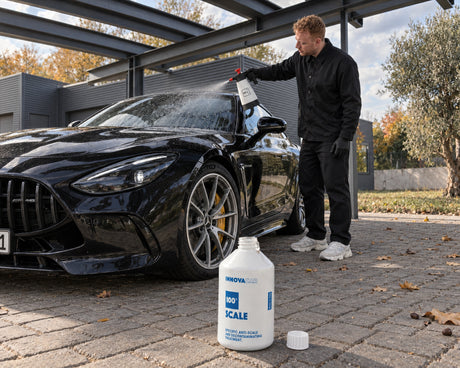
Step 2 — Pre-wash: Loosen instead of scrubbing. Before any cloth or mitt touches the paint, the heavy dirt must be chemically loosened. This is the crucial step that most people skip. First, rinse the car with a high-pressure cleaner — from top to bottom, evenly, without holding the nozzle too close to the paint. Then the Koch-Chemie Vorreiniger B comes into play. It is alkaline and dissolves organic contaminants like insect remains, bird droppings, and the typical winter film of oil and soot. Spray it on diluted, work from bottom to top, let it dwell for 3–5 minutes, and rinse. For the foam effect that also soaks persistent particles in the rocker panel and wheel arch area, the Koch-Chemie Gentle Snow Foam is suitable when used with a foam cannon. Gentle Snow Foam is pH-neutral and therefore compatible with coatings — unlike Vorreiniger B. If you have a ceramic coating on your paint, use the Snow Foam as your sole pre-wash and only use Vorreiniger B on uncoated areas: wheel arches, rocker panels, underbody.

Step 3 — Contact wash: Panel by panel. Now that the heavy dirt is loosened, it's time for the wash mitt. The two-bucket method is mandatory: one bucket with shampoo solution, one bucket with clear water for rinsing. The Koch-Chemie Autoshampoo is a solid, high-foaming shampoo for the contact wash — good for everyday use with decent lubricating properties. Wash panel by panel: roof, hood, sides, then the more heavily soiled lower parts. Thoroughly rinse the mitt in the clear water bucket after every panel. What you should definitely avoid after winter: car washes with brush washes. The brushes press the mineral residues into the paint instead of removing them. The result is swirl marks — fine circular scratches that you see immediately in sunlight.

Step 4 — Decontamination: What the wash doesn't get. If you run your hand over the paint after the wash and it still feels rough, that's industrial fallout and rail dust embedded in the clear coat. That is normal after winter. A Koch-Chemie mild clay bar pulls these embedded particles out of the paint without removing the clear coat. For this, you need a lubricant — spray on the Koch-Chemie Clay Spray and let the clay glide over the paint with gentle pressure. Afterwards, the paint will feel like glass. This is no marketing promise — the difference is palpable with your bare hands. This step is not necessary for every wash, but almost always after winter. Anyone who skips this step and seals immediately is locking the contamination under the sealant.
Step 5 — Sealing: Preserving the fresh state. The paint is now clean and decontaminated — a state you want to preserve. A spray sealant is the fastest way to do this. The Koch-Chemie Spray Sealant S0.02 can be sprayed onto the still slightly damp paint, spread with a microfiber cloth, and buffed off — done. The durability is 4 to 8 weeks, depending on weather and usage. For the start of spring, this is completely sufficient. Those looking for a longer-lasting solution can consider the Koch-Chemie 1K-Nano Paint Sealant — a real paint sealant that lasts up to 9 months, but requires a bit more effort to apply.
What most people forget: Rubber, plastic, and tires
The paint gets all the attention, but seals, plastic trim, and tires have suffered just as much in the winter. Rubber seals on doors and trunks become brittle due to frost and salt — in the worst case, they crack. The Koch-Chemie Gummifix keeps them supple and protects against further UV aging. Apply thinly, let it soak in briefly, done. For the tires, which have become dull and gray in winter due to salt and cold, the Koch-Chemie Kcu-Reifenschaum brings back the rich black tone — without greasy residues that attract dirt.
Daniel's tip: Do the spring wash on a cloudy day — not in the blazing sun. In direct sunlight, pre-cleaner and shampoo dry too quickly on the paint and leave behind spots that you have to laboriously rework. The forecast shows changeable cloudiness for the next few days — exactly the right weather for washing. Use the window before it gets warmer and sunnier starting Saturday.
Conclusion: 60 minutes that protect your car all spring
The spring wash is not menial work — it is an investment. Pre-wash, contact wash, decontamination, sealing, rubber care. Five steps, a good hour of work, and your car starts the season clean, protected, and prepared. Anyone who doesn't get the winter grime off now will see it again in the summer as scratches, matte spots, and brittle seals.
Everything you need for the complete spring wash — from Snow Foam to sealant — can be found in our shop. If you are unsure which product fits your setup, write to us in the chat — we are happy to help.
Niente tempo per tutto l'articolo? Fattelo riassumere: