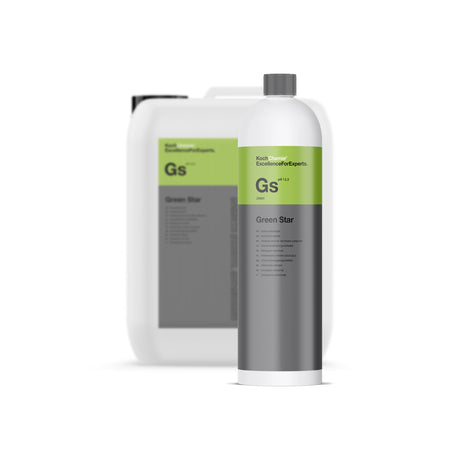
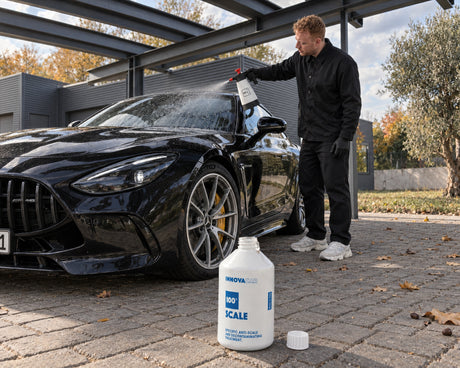
Togliere le macchie di calcare dai vetri dell'auto senza graffiarli
Daniel von Detailing1 |


FLEX
Pistola termica 2000 W per wrapping e rimozione colla
Pistole termiche: le pistole termiche portano aria calda dove stai lavorando. Regolazione della temperatura, portata d’aria regolabile e forma dell’ugello decidono come le maneggi negli impieghi ammessi.
Materiale e pezzi vicini mettono un limite al calore; i modelli a batteria e quelli a filo si scelgono anche su mobilità e durata del lavoro.
Troppa scelta in Pistole termiche? Fatti aiutare a scegliere:
On a car, a heat gun is used to shape vinyl wrap and paint protection film, post-heat edges and recesses, soften the adhesive of old stickers, and shrink heat-shrink tubing on cables. FLEX also suggests using it to remove paint and adhesive residue and to loosen rusted connections. It is not the right tool for glass, coatings, or greyed-out plastic.
That depends on the device: The FLEX "HG 650 2000" heat gun can be adjusted from 50 to 650 °C in 10-degree increments, while the FLEX "HG 530 18" cordless heat gun (18V) has two settings: 260 and 530 °C. This value applies at the nozzle outlet. The temperature reaching the component is significantly lower, depending on the distance, air volume, and movement of the nozzle.
A heat gun reaches several hundred degrees and can be set to specific temperature values, whereas a hair dryer only blows warm air. For a single sticker, a hair dryer combined with a plastic scraper and adhesive remover is sufficient. For vinyl wrap work requiring specific manufacturer temperatures and for heat-shrink tubing, an adjustable heat gun is necessary.
For wrapping, a corded device with finely adjustable temperature settings and a display, for example in 10-degree increments, is suitable. The critical factor is the manufacturer's film temperature: for the 2080 series, 3M specifies 40 to 50 °C for stretching and 80 to 95 °C for post-heating, as measured on the film using an infrared thermometer.
Short-term yes, long-term no. According to Gtechniq, AUTO BILD, and a Nissan service instruction, the effect only lasts for weeks, and the heat can damage the material. We recommend using a plastic conditioner with UV protection instead, which you can reapply regularly. It protects the surface rather than using heat to briefly extract color from it.
For work on vehicles, the standard power of corded devices, typically 1,500 to 2,300 watts according to the F.A.Z., is sufficient; the HG 650 2000 has 2,000 watts. More important than the wattage is a temperature control system that maintains and displays a specific value. According to 3M, film only requires a film temperature of 40 to 50 °C for shaping.
Daniel von Detailing1 |

Daniel von Detailing1 |

Daniel von Detailing1 |

Daniel von Detailing1 |

Jasper von Detailing1 |

Daniel von Detailing1 |

Daniel von Detailing1 |

Daniel von Detailing1 |

Jasper von Detailing1 |

Jasper von Detailing1 |

Daniel von Detailing1 |

Daniel von Detailing1 |