

It's that time of year again: a yellow-green film covers your car's hood, roof, and rear window — and if you try to wipe it off with a dry cloth now, you risk damaging your car's paintwork. Birch pollen alone can reach levels of over 100 grains per cubic meter of air — and each of these grains is a potential paint defect if not handled correctly.
Why birch pollen dust is more aggressive than it looks
Pollen are biological particles — not pebbles, not metal shavings. That sounds harmless. But it's not. Birch pollen carries proteins and enzyme complexes on its surface that can initiate chemical reactions when exposed to moisture. The pH value of a pollen-water suspension is between 4 and 6, depending on the type of pollen — in other words, slightly acidic.
Paintwork is sensitive to pH deviations. With prolonged contact with a slightly acidic solution — combined with heat from sun exposure — the clear coat can dissolve or become dull. What initially looks like just a spot can, after drying, set in as a burnt-in contour: a "pollen imprint" that can no longer be removed without polishing.
Pollen adheres to the paint surface, is sticky, and anchors itself in fine paint pores. Anyone who wipes over it — no matter with what — grinds these particles across the paint and produces swirl scratches. Never wipe dry. Always create moisture first.
Step 1: Loosen the pollen film with foam — never wipe dry
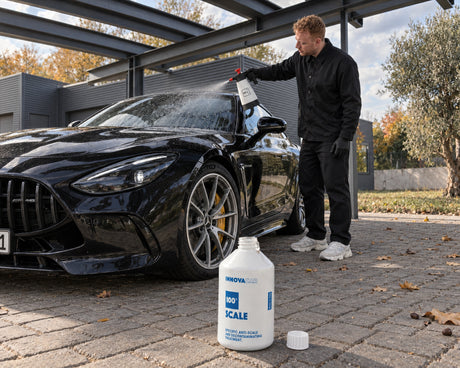
Before water, mitt, or shampoo touch the paint, the pollen film must be lifted: detached from the surface without mechanical pressure. A pH-neutral cleaning foam applied with a foam cannon is suitable for this. The foam adheres, penetrates the pollen film, and breaks the bond between pollen and paint. Let it work for 3–4 minutes, then rinse with clear water — no rubbing, no wiping.
We recommend Koch-Chemie Gentle Snow Foam "Gsf" (pH 7.5). Creamy-dense, it also adheres to vertical surfaces and contains no components that could attack sealants. During pollen season, Gsf is an obligatory pre-wash before every hand wash. Foam cannon dosage: 60–80 ml per 900 ml of water, 100–130 bar. Wash the vehicle in the shade if possible.

Step 2: pH-neutral wash — the right shampoo for pollen season
Strong alkaline shampoos (pH > 9) attack sealants — which is counterproductive during pollen season when the protective layer is already under stress. We exclusively use Koch-Chemie Car Shampoo "As" (pH 6.8) — compatible with all common sealants, ceramic coatings, and paint protection films.
Two-bucket method: one bucket with shampoo water (20 ml As per 10 L), one bucket with clear rinse water for the wash mitt. Always wipe in straight lines — never in circles. Order: roof → windows → hood → sides → bumpers. The lower half of the vehicle always last.
Step 3: Get windshield and windows pollen-clean
Pollen combines with rubber microparticles from the windshield wipers to form a stubborn, greasy film — and causes strong glare when driving into oncoming light. Standard glass cleaners are often not strong enough for this combined film. We use Koch-Chemie Glas Star "Gla" as a concentrate — 1:20 for exterior windows during pollen season. First, pre-clean the window with water, then work in the Gla solution with a lint-free cloth in circular motions, wipe dry. Check against oncoming light.

Interior: When pollen enters through ventilation and doors
When getting in, via the ventilation system, or through open doors, pollen dust enters the interior — settling on the dashboard, door panels, and plastic frames. For plastic surfaces, we recommend Koch-Chemie Top Star "Ts" — it cleans and has an antistatic effect. Charged plastic surfaces attract dust and pollen; Ts permanently reduces this charge. First vacuum, then spray Ts onto a microfiber cloth — never directly onto the surface. Change the pollen filter once a year before the season.
Check protective layer — spring is the perfect time
An intact protective layer is the most important protection against burnt-in pollen imprints. Water bead test on a clean hood: Does the water bead up round (contact angle > 90°)? Good. Does it spread out flat? Refresh the sealant. The rule of thumb for pollen season: wash after 3–5 days of heavy pollen exposure. With an intact ceramic coating, up to 7 days — the coating buffers.

The peak of birch pollen flight is approaching in a few days. Anyone who now combines pre-wash with foam, pH-neutral shampoo, and an intact sealant will protect their paint throughout the entire season — without permanent pollen imprints, without swirl scratches from incorrect technique.
Discover all products for pollen season →
Niente tempo per tutto l'articolo? Fattelo riassumere: