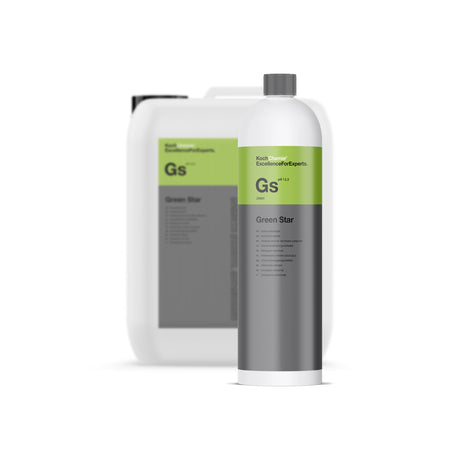
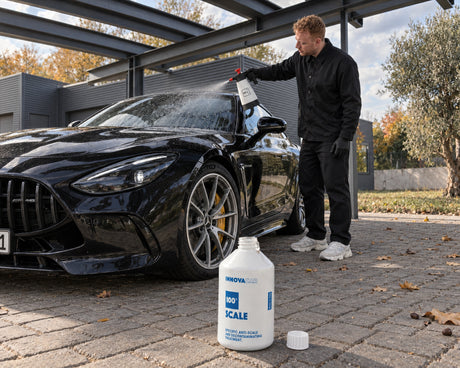
Togliere le macchie di calcare dai vetri dell'auto senza graffiarli
Daniel von Detailing1 |


Koch-Chemie × COLOURLOCK
Top coat ultra lucido per la massima brillantezza e protezione
What is the High Gloss Top Coat from COLOURLOCK? It is the highest level of shine among the finishing lacquers used in leather repair. COLOURLOCK "Top Coat" (High Gloss) seals freshly dried leather dye and reflects light in parallel rather than diffusing it—creating a mirror-like patent leather effect for show pieces, furniture, and design leather.
COLOURLOCK High Gloss Top Coat is the final lacquer used to set the highest level of shine at the end of a leather dyeing process. It forms a highly transparent film over the freshly dried dye, protecting it from abrasion, sweat, and cleaning agents while sealing the surface so smoothly that it reflects like a mirror instead of diffusing light. It is ideal for show vehicle details, furniture leather, handbags, and design objects.
Professional tip from Detailing1: The most expensive mistake with high gloss happens on black leather. Building up mirror shine with several heavy layers creates a gray haze over the black—the film scatters light in its depth, turning deep black into a dull anthracite. The remedy is found in the data sheet but is practically unknown to hobbyists: stir about five percent black aniline dye into the high-gloss lacquer before spraying. The method of application is equally important—apply thin layers using a cross-spray technique, drying each layer individually with a hot air gun. We frequently receive inquiries about this exact gray haze, and the cause is almost always a first layer that was too thick, not the wrong product.
Leather is naturally matte. If it shines, it has "learned" to shine—through friction, conditioning, or a coating.
Physically, this is based on a profile height. In cross-section, a matte leather surface looks like a mountain range, throwing light back in all directions, while a glossy surface is leveled out, reflecting light in parallel like a mirror-still lake. This means for you: shine is not an ingredient you add, but the result of how smoothly the top layer dries.
This is precisely where the finishing lacquer comes in. COLOURLOCK leather dyes provide coverage and color tone, while the Top Coat determines the level of shine. Therefore, in a professional dyeing process, the level of shine is a deliberate choice rather than a byproduct—which is why finishing lacquers are available in everything from matte to satin matte, glossy, and high gloss.
One term often causes confusion. "Patent leather" (Lackleder) is its own type of leather whose high gloss is created at the tannery—the finish, i.e., the lacquer-like top layer on the hide, is applied in a mirror-like way during production. What the high-gloss finishing lacquer does is different: it builds this look onto leather that has already been dyed. The result looks similar, but the process is different.
From our everyday life at Detailing1: Most questions about shine don't come from people who have too little of it, but from people who have achieved too much. If you describe your desired result before starting—mirror-like like piano lacquer or dull like factory leather—you will choose the right product in a minute. If you try to change it while applying color, you will end up making the decision under time pressure.
This category is intentionally narrow, as high gloss is an end point rather than a spectrum.
COLOURLOCK "Top Coat" (High Gloss) is the high-gloss finishing lacquer for professional leather repair. It dries crystal clear, leaves the color tone unchanged, and enhances its depth, because a smooth surface allows more light to enter and exit the color layer. In practice, you will notice that a red appears richer after a high-gloss application, without anyone having adjusted the color tone itself.
The entire range can be found under Top Coat & Finish by COLOURLOCK. This includes the matte finish, the satin matte premix for cars, furniture, and faux leather, as well as the COLOURLOCK Glossy Top Coat. High gloss is the outlier at the top that you order specifically rather than using as a default.
When choosing a container size, your workflow determines the decision, not your ambition. The 250 ml is enough for sample areas, individual parts, and a first attempt at a design piece. The 1000 ml / 1 liter bottles are for anyone working with a spray gun—using a cross-spray technique, more material passes through the nozzle than when using a sponge, but the film is more even, and an even application is half the battle for high gloss.
On the label, one word separates the two; on the surface, there is a clearly visible difference.
The glossy finish provides a uniformly reflective, elegant surface—the kind of shine known from high-quality furniture leather and fashion items. High gloss goes further: it reflects instead of just shining, showing contours of the surroundings. We placed both on a piece of leather scrap, and the difference is noticeable even in diffuse daylight, not just under a spotlight.
The same level of precision applies downwards. Professional shops mix their target shine from matte and glossy bases rather than buying a bottle for every nuance; the factory-standard satin matte is about one-third gloss to two-thirds matte. If you want to tone down a finished high-gloss surface, use the COLOURLOCK Mattifier—mix it before application, not on the dry surface.
By the way, high gloss over a matte repair works technically, but visually it is a bold statement. The lacquer covers the matte surface and makes it mirror-like without changing the color tone. If you only intended to touch up a matte spot, you will end up with a glossy island in a dull environment. If, on the other hand, you are intentionally converting an entire piece to high gloss, that is exactly the desired effect.
Feel (tactility) is managed separately from the level of shine. The Soft & Wax Slip additives from COLOURLOCK change how the surface feels: COLOURLOCK "Soft Slip" makes it velvety soft, while COLOURLOCK "Wax Slip" gives it a waxy, smooth, sliding tactile feel. Both are additives for the Top Coat, not replacement products—the shine remains the job of the lacquer, while you adjust the haptics separately.
A high-gloss film does not forgive a thick layer. Applying it too heavily does not make it glossier; instead, it becomes cloudy, board-like, and gray in the black areas.
The finishing lacquer stands at the end of a set process, and the order is non-negotiable: degrease, prime, fill, dye, Top Coat, additives. At the beginning, the COLOURLOCK Degreaser removes skin oils, conditioner residues, and silicone films; then, the COLOURLOCK Primer & Adhesion Promoter creates the bond for the dye. High gloss is always applied directly onto the freshly dried leather dye.
The application itself is performed with a spray gun using a cross-spray technique—one pass lengthwise, the next across it, each wafer-thin. Between passes, dry thoroughly with a hot air gun, and only then follow up with the next layer. Two to three thin layers provide more depth than one heavy one, because each individual layer dries smooth instead of running.
For durability in daily use, the crosslinker from the additive program must be included; see COLOURLOCK Crosslinker. Crosslinker means the lacquer forms a tighter net as it dries instead of just evaporating, and this net withstands friction and sweat. In everyday use, you will notice this in grip zones, which remain closed after months instead of becoming matte and cracking.
In terms of time, high gloss is the most patient part of the process. Calculate several thin layers plus drying breaks for a single part rather than a single pass, and plan to work in a dust-free environment—a speck of dust that no one would find in a matte finish will stand out like a crater in a mirror-like high-gloss surface. The first time feels cumbersome. From the second object onwards, it is routine, and you can use the breaks to mask the next part.
The most common reason someone searches for high gloss on our site is a misunderstanding: they want rich, fresh-looking leather and do not actually mean mirror-like gloss.
Car interiors are finished with a satin matte look from the factory, and for good reason. A mirror-like seat surface throws sunlight into the driver's field of vision, shows every fingerprint, and makes signs of wear stand out more quickly because the reflection breaks at abraded areas.
Search queries confirm this picture. People searching for shine on leather seats usually want to get rid of it, not add it—glossy seats are considered "greasy" in the community, not elegant. We often see vehicles where a seat appears significantly glossier after dyeing than the rear bench next to it: the color was matched, but the level of shine was not, and the eye perceives the difference immediately.
Then there is the issue of the components themselves. Perforated and ventilated seats cannot handle a film-forming application that runs into the perforation rows and dries into plugs. Furthermore, the side bolsters of modern vehicles contain the tear seam for side airbags—this seam must open upon deployment and must neither be stiffened nor glued. If your damage is on or directly at this seam, it is not a case for bottled chemicals, but for an upholstery specialist or a leather repair technician.
A third honest limitation is the color tone, not the lacquer. For a partial repair in the direct field of vision, blending into an aged environment is the most demanding part of the entire job—and high gloss makes it harder because a mirror-like surface highlights every deviation. Anyone dyeing an entire surface in one go has a much easier time than someone trying to make a hand-sized spot invisible.
And a limit that no one likes to hear: Even a perfectly built high-gloss film remains a film. Heavily used patent leather surfaces become sticky over the years because the coating ages—this is not a product defect, but the nature of the design. For a show piece, this is irrelevant; for an everyday seat with daily friction, it is the argument against high gloss.
The decision depends on the object, not the leather. If the piece is looked at rather than sat on, high gloss is suddenly the right answer.
If you are building a show vehicle and intentionally want mirror-like details like center console inserts, trim parts, or a show interior, high gloss is made exactly for that. The same applies if you are refinishing furniture leather, designer pieces, handbags, accessories, or crafted faux leather surfaces and are looking for a premium finish. Conversely, if an everyday car seat just needs to look clean and rich again, opt for a matte or satin matte finish—that is the more honest recommendation, even if we sell less of it here.
What we observe again and again at Detailing1: Plastic and faux leather parts end up in the same project, and then the material question arises. For pure faux leather surfaces without dyeing, COLOURLOCK Faux Leather Sealer is the easier path; the high-gloss finishing lacquer belongs on the part that was actually dyed or repaired. You can find all steps of the process bundled under Dyeing & Finish by COLOURLOCK, and the product for this category under COLOURLOCK "Top Coat" (High Gloss).
The step that makes the difference costs a scrap piece of leather and half an hour: build your sample area with exactly the number of layers you intend to use later, and judge it where the object will end up. Shine is a light phenomenon, not a material value—the same surface looks mirror-like under a spotlight and almost satin matte by a north-facing window. Anyone who judges the level of shine only under the lamp they worked under has not evaluated it, but guessed.
Troppa scelta in Top Coat alta lucentezza di COLOURLOCK? Fatti aiutare a scegliere:
Daniel von Detailing1 |

Daniel von Detailing1 |

Daniel von Detailing1 |

Daniel von Detailing1 |

Jasper von Detailing1 |

Daniel von Detailing1 |

Daniel von Detailing1 |

Daniel von Detailing1 |

Jasper von Detailing1 |

Jasper von Detailing1 |

Daniel von Detailing1 |

Daniel von Detailing1 |