

Togliere le macchie di calcare dai vetri dell'auto senza graffiarli
Daniel von Detailing1 |


Koch-Chemie × COLOURLOCK
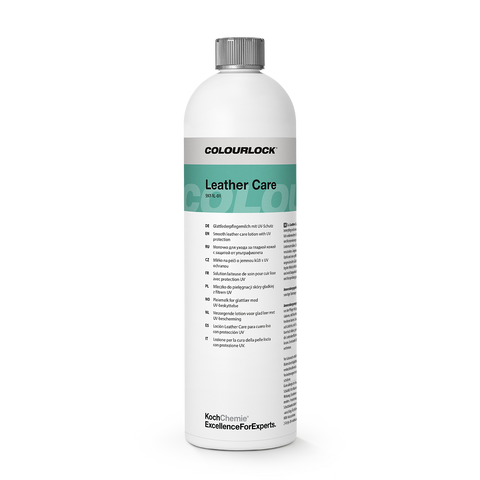
COLOURLOCK "Leather Care" latte nutriente pelle liscia con protezione UV
Latte nutriente per pelle liscia con protezione UV
Koch-Chemie × COLOURLOCK
COLOURLOCK "Aniline Cream" cura per pelli lisce a poro aperto
Cura premium per pelle anilina a poro aperto
Koch-Chemie × COLOURLOCK
COLOURLOCK "Elephant Leather Oil" Prodotto naturale per la cura della pelle leggermente indurita
Olio di cura intensivo per pelle secca e indurita
Koch-Chemie × COLOURLOCK
COLOURLOCK "Leather Shoe Sole Oil" cura del cuoio per scarpe Goodyear con suole in cuoio
Cura profonda per suole in cuoio: più comfort e durata
What is COLOURLOCK leather care? Leather-specific care products from professional repair practices: care milk with UV protection for pigmented smooth leather, film-free cream for open-pored aniline leather, and re-greasing oils for hardened leather and leather soles. Developed since 1995 at the Lederzentrum (Leather Center), now under the umbrella of Koch-Chemie.
COLOURLOCK leather care is the product line from the leather specialist that has been supplying repair professionals since 1995 as Lederzentrum GmbH and is now part of Koch-Chemie. Instead of a universal product for everything, each leather type gets its own formula: a care milk with UV protection for pigmented smooth leather, a film-free cream for open-pored aniline leather, and re-greasing oils for hardened leather and leather soles. The goal is always the same: supple fibers, stable color, and no need for repairs.
Pro-tip from Detailing1: The most common mistake in leather care is using too much product. We frequently receive inquiries about greasy, shiny leather seats, and almost always the cause is the same: the care product was applied too thickly, never wiped off, and often applied on top of uncleaned leather. Coated smooth leather only absorbs a wafer-thin layer — the rest remains on the surface and attracts dirt. Therefore: clean first, then distribute a few milliliters per seat with a soft cloth and go over the surface with a dry microfiber cloth after about ten minutes. Pigmented everyday leather does not need more than two thin applications per year.
When leather cracks, fades, or becomes greasy, it sooner or later ends up with a detailer or saddler — and COLOURLOCK has been part of their standard equipment for years. The brand was established in 1995 at the Lederzentrum, a specialist in leather repair and dyes. Those who spend their days recoloring cracked side bolsters and rescuing hardened vintage armchairs know exactly which damages can be prevented and with what.
The care series was created precisely from this experience. Each product addresses a specific type of damage known in repair practices: the care milk prevents UV fading, which would otherwise necessitate a recoloring. The cream for aniline leather prevents the dry spots that cause open-pored leather to age patchily. The oils make fibers flexible before they break. Here, care is not about a fragrance—it is about preventing repairs.
Since the acquisition by Koch-Chemie, the leather specialist is now part of the chemical manufacturer from Unna—which is why the line is listed in our shop as Koch-Chemie × COLOURLOCK. This hasn't changed the formulas, nor the logic behind them: leather-specific products instead of one bottle for everything. For you, this means you aren't choosing between marketing promises, but between clearly defined application cases.
The fact that the brand comes from both the furniture and automotive worlds is an advantage, not a coincidence. For three decades, Lederzentrum customers have brought in everything made of hide: car seats and steering wheels, sofas, bags, jackets, saddles. Consequently, the substrate knowledge behind the formulas is exceptionally broad—the same care milk that protects your car seat is tested on furniture leather that lasts much longer than any leased vehicle.
The standard in cars is pigmented smooth leather, i.e., leather with an opaque color and protective layer. This is what the COLOURLOCK "Leather Care" milk is for: an emulsion that forms a thin, breathable protective film, includes UV absorbers, and keeps the leather matte and grippy rather than greasy. Available in 100 ml for a trial and 1000 ml / 1 liter for family cars and furniture.
Open-pored aniline leather lacks this protective layer. It is only dyed through, looks warm and natural, and absorbs liquids like blotting paper. Therefore, the aniline leather care works without a film: COLOURLOCK "Aniline Cream" penetrates the open pores, stabilizes the fiber structure from within, and leaves the matte, sensitive finish untouched.
For hard, dried-out leather, there is the care for hardened leather: COLOURLOCK "Elephant Leather Oil" in a 250 ml bottle deeply re-greases the fiber structure and makes brittle vintage seats, motorcycle saddles, belts, and bags pliable again.
And because leather doesn't end at the car seat, the leather sole care covers an area that almost everyone forgets: COLOURLOCK "Leather Shoe Sole Oil" keeps the soles of welted shoes flexible, so the sole doesn't break along the edge long before the upper leather faces problems.
The classification may seem detailed, but in everyday use, it follows the exact order in which leather ages: first, the surface loses moisture and color, then the fibers harden, and finally, they tear. Leather Care and Aniline Cream work in phase one, Elephant Leather Oil in phase two—and those who reach phase three no longer need care products, but rather repair products. The sooner you start, the smaller the container you will need.
The three formats differ not in their label, but in their mode of action. The care milk is an oil-in-water emulsion: it spreads evenly over the coated surface and leaves a wafer-thin, breathable protective film—it keeps moisture in the leather while still allowing water vapor to escape. Practically speaking: the leather doesn't feel different after care, it just no longer looks dry and dull.
The Aniline Cream contains no film at all. Its fine oils and emulsions are absorbed via capillary action—the open pores pull the care product into the fiber structure, where it smooths out dry spots. Translated: no gloss buildup, no dark edges, the matte finish remains as it is. This is precisely why it is the only choice for leather without a pigment layer.
The oils work with long-chain fats that position themselves between the dried-out collagen fibers, allowing them to glide against each other again—the leather industry calls this "re-greasing." In everyday terms: a seat that creaks and develops hard wrinkles when you get in will become noticeably softer over several thin applications without becoming greasy.
Common to all three formats is the logic of thin application. Leather only absorbs care products up to the point of saturation—anything beyond that remains on the surface and becomes a layer of dirt. That is why none of the products say "apply generously": the formulas are so concentrated that saturation is reached quickly. Economy here is not a tip for being cheap, but part of the application process.
The formats are not interchangeable, and that is exactly where the boundaries lie. We tested applying the re-greasing oil to densely coated new leather: it simply does not absorb, remains as a film on the surface, and binds dust. Conversely, milk and emulsions do not belong on open-pored aniline leather—they can cause spots and dark edges there. And none of these products repair cracks or cover color damage; that is the job of the COLOURLOCK dyeing and repair line.
Applying care over dirt preserves the dirt. Dust, skin oils, and denim abrasion lie as a fine film on the leather, and any care product you apply on top seals this layer in as well. Therefore, every leather care routine begins with a suitable leather cleaner—mild for regular maintenance, strong for deep cleaning before the first care application.
The application itself is unspectacular, and that is the point: apply a few milliliters to a soft cloth or an applicator, spread thinly in steady motions, let it absorb for about ten minutes, and remove any excess with a dry microfiber cloth. The first time, you will need about half an hour for a complete set of seats, and half that time for subsequent passes. Two thin coats always beat one thick one.
Two conditions play a role: temperature and patience. Heated seats in midsummer cause emulsions to set too quickly—this leads to clouds and streaks. It is better to work in the shade or with the door open and actually give the leather the ten-minute absorption time. And don't expect a "before-and-after" shock the first time: well-cared-for leather doesn't look spectacularly different, it feels different and ages differently. The effect shows over years, not overnight.
For intervals, the rule is: twice a year for everyday leather, more frequently only for sun-exposed or heavily used areas. From our daily routine at Detailing1, we can clearly name the priorities: the damage we see almost always occurs on the driver's side—entry edge, side bolster, steering wheel rim. This is exactly where it pays to take a closer look between scheduled care sessions; the rest of the interior ages significantly slower.
To be honest: if your car has pigmented smooth leather in good condition and you keep it clean, a good all-in-one leather care product like Meguiar's Ultimate Leather Detailer will take you a long way. Cleaning and care in one step, quickly applied—a legitimate solution for standard cases that we also recommend.
The specialists play their strengths where the universal approach fails due to physics. One product cannot simultaneously build up a UV protective film and be absorbed into open pores without a film; it cannot be mild enough for sensitive aniline leather while also re-greasing hardened vintage leather. If your leather is a special case—open-pored, old, hardened, welted—there is no way around leather-specific care.
We strongly advise against household remedies. Udder cream, olive oil, or baby cream are made for skin, not for coated leather: their fats absorb uncontrollably, turn rancid over time, and build up exactly the greasy shine that can only be removed with multiple cleaning cycles. We often see leather that has been treated this way for years—cleaning it then takes longer than the actual care process.
A special case that is often overlooked: many supposed leather seats in modern cars are synthetic leather or leather/synthetic combinations—optically difficult to distinguish, but a different world in terms of material. Re-greasing oils have no place there; they do not absorb into plastic surfaces and remain sticky on top. If you are unsure what is installed in your car, a look at the equipment list helps—or a quick message to us before you reach for the wrong product.
The fastest way to the answer is a drop of water in an inconspicuous spot. If it beads up or sits on the surface, your leather has a coating: COLOURLOCK "Leather Care," twice a year, done. If the drop is absorbed and darkens the spot, you are dealing with open-pored aniline leather: then use film-free care with COLOURLOCK "Aniline Cream."
If the leather is already hard, dry, or brittle, the work begins a step earlier. COLOURLOCK "Elephant Leather Oil" re-greases the fibers over several thin passes; for old, heavily hardened leather, the softener COLOURLOCK "Old Leather Softener" loosens the fiber structure beforehand so the re-greasing can actually take effect. Welted shoes receive COLOURLOCK "Leather Shoe Sole Oil" on the sole, not on the upper leather.
Those starting from scratch don't have to hunt for individual components: the cleaning & care sets combine cleaner and care products tailored to the leather type—the easiest way to secure initial success. You can find all other care products from the brand one level higher: Back to COLOURLOCK care.
And the philosophy that carries the whole series: COLOURLOCK has been making its money with repair and recoloring since 1995—the care products exist so that you never need either. Two thin applications a year determine whether your leather looks well-maintained in ten years or needs to be recolored.
Troppa scelta in Cura della pelle COLOURLOCK? Fatti aiutare a scegliere:
Daniel von Detailing1 |

Daniel von Detailing1 |

Daniel von Detailing1 |

Daniel von Detailing1 |

Jasper von Detailing1 |

Daniel von Detailing1 |

Daniel von Detailing1 |

Daniel von Detailing1 |

Jasper von Detailing1 |

Jasper von Detailing1 |

Daniel von Detailing1 |

Daniel von Detailing1 |