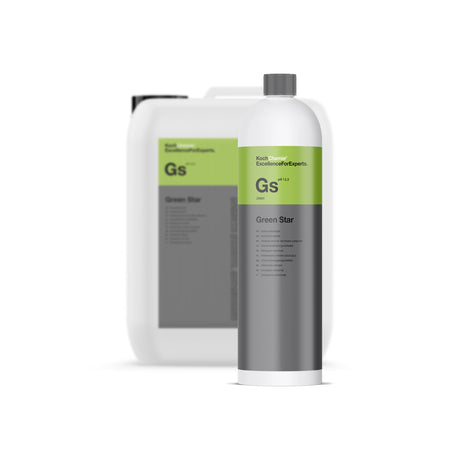
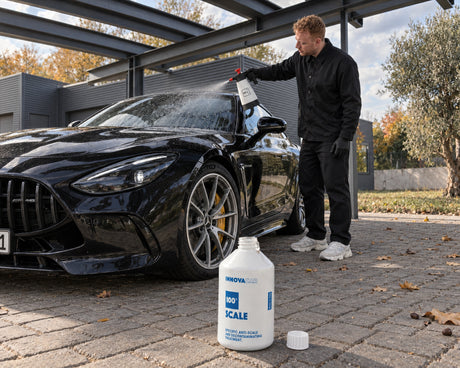
Togliere le macchie di calcare dai vetri dell'auto senza graffiarli
Daniel von Detailing1 |


Koch-Chemie × COLOURLOCK
COLOURLOCK "Leather Shield" prodotto per la cura della pelle nuova, protezione dall'usura
Protegge la pelle dall'abrasione e mantiene l'effetto opaco
Koch-Chemie × COLOURLOCK
COLOURLOCK "Artificial Leather Protector" sealant per similpelle
Sigilla l'ecopelle e la protegge dall'abrasione
What is COLOURLOCK leather sealant? A protective film against mechanical wear, categorized by substrate: COLOURLOCK "Leather Shield" for pigmented real leather, COLOURLOCK "Artificial Leather Protector" for faux leather and PU surfaces. Both reduce friction on entry areas, side bolsters, and steering wheel rims, slow down denim abrasion, and maintain a matte appearance.
COLOURLOCK leather sealant is the protective step following cleaning: a thin, flexible polymer film that rests on the topcoat and absorbs daily friction before it can reach the leather. The formulation depends on the substrate—COLOURLOCK "Leather Shield" for pigmented real leather, COLOURLOCK "Artificial Leather Protector" for faux leather and PU. The goal remains the same in both cases: less abrasion on contact surfaces, less color transfer from clothing, and no shiny spots where daily movement occurs.
Expert tip from Detailing1: The most common mistake with leather sealants is the wrong timing. We regularly receive inquiries from drivers whose side bolsters are already shiny and greasy—and who now want to apply sealant to get rid of it. That is not how it works: a sealant preserves the condition it finds. If the pigment layer on the entry edge has already worn thin, the film will preserve exactly that state. The right moment is much earlier, namely while the topcoat is still intact: on a new car, after detailing, or after a repair. And always in this order: clean, let dry completely, apply a thin layer of sealant. Anyone who skips the cleaning step will trap skin oils and denim dye under the film.
A leather sealant is not a superior leather care product. It works in a different area: externally on the topcoat rather than internally in the fibers.
Automotive leather rarely dies from dryness; it dies from friction. Modern automotive leather features a pigmented PU topcoat, and it is precisely this layer that you see, touch, and wear down a little bit every time you get in. As long as it is intact, the leather looks uniform. Once it is worn through in one spot, the lighter base color underneath appears—from that point on, it is a case for color refreshing, no longer for maintenance.
A friction-resistant polymer works against this: a finely cross-linked film that attaches to the topcoat and acts as a sacrificial layer between the leather and clothing. It wears away rather than cracking or building up. In other words: what wears off on your entry edge is a film you can renew in a few minutes—not the pigment layer, which can only be restored with color.
The second effect involves surface energy. A sealed surface is smoother and less attractive to dirt, skin oils, and dissolved textile dyes because they lack the microscopic roughness needed to anchor themselves. In everyday life, this means: interior cleaning is faster and requires less pressure—which in turn means less abrasion.
It is important to distinguish the lower and upper limits. A leather sealant is not a paint sealant: it does not hermetically seal the leather; it remains breathable, and subsequent care products can still reach the fibers. And it is not an impregnation—oils for smooth leather work against penetrating water and dirt, not against mechanical friction. If your concern is moisture rather than wear, you will find the right product under Leather Oil & Impregnation.
Before you reach for the bottle, you need to know what you are applying it to. Real leather and faux leather look virtually identical in a modern vehicle interior from two meters away.
The first clue is the pore pattern. Faux leather has an embossed grain whose pattern repeats exactly at regular intervals—if you scan the surface, you will find the same pore arrangement multiple times. Real leather is irregular: pores of different sizes, occasional scars, and small differences in density. The second clue is temperature. Faux leather stays cool under your palm, while real leather absorbs body heat within a few seconds and releases it more slowly.
The third and most reliable clue is at the edges. Look at the underside of the seat or an exposed edge at a seam: faux leather shows a textile fabric as a backing on which the PU layer rests. Real leather has a fibrous, suede-like back without fabric structure at the cut edge.
The most common mistake concerns blends. Many vehicles combine both in the same seat: real leather on the seating surface where it is visible and tactile, and faux leather on side bolsters, backrests, and headrests, where it is cheaper and more dimensionally stable. In the equipment lists, this is noted as a leather combination or leather/faux leather. This means for you: a single seat might require both sealants—and ironically, the side bolster that suffers the most is the faux leather surface in many cars.
The question of what is actually installed reaches us regularly, and in most cases, a look at the vehicle's equipment list clarifies it faster than any test on the seat. If you don't find it there, test in a hidden spot—under the seat cushion or on the back of the backrest—and work your way from there.
The breakdown of this category follows not assortment logic, but material physics. Coated real leather and PU faux leather react differently to the same film, and that is exactly what determines the product choice.
For pigmented real leather, there is COLOURLOCK "Leather Shield," found under Real Leather Sealant. The polymer attaches specifically to the topcoat without changing breathability or haptics—the leather continues to feel soft but shows signs of friction-induced shine much later. It dries to a satin-matte finish; no buffing is necessary, and no wax-based residues are created. This is precisely why it is the product for new cars, leased vehicles, and freshly detailed interiors: it slows down greasy shine before it even develops.
For faux leather and synthetic surfaces, there is COLOURLOCK "Artificial Leather Protector," found under Faux Leather Sealant. The film is flexible and transparent, reducing friction between the surface and clothing and making it harder for dirt, skin oils, and textile dyes to penetrate the material structure. The crucial difference from care products: the Protector is not greasy. Faux leather has no collagen fibers that could absorb fat—oils remain sticky on the surface and bind dust.
Both formulations are available in 100 ml and 1000 ml / 1 liter sizes. Because both are applied thinly and do not saturate the material, 100 ml is enough for a complete vehicle interior. The liter size is for detailers, upholsterers, and anyone who maintains furniture, office chairs, or bags in addition to their car—faux leather is used for far more than just vehicles.
What connects both products is their origin in leather repair. COLOURLOCK emerged from the Leather Center, which has been supplying upholsterers and detailers with dyes and repair materials since 1995 and is now part of Koch-Chemie. Anyone who re-dyes worn-out side bolsters daily knows exactly where and in what order leather gives out. The sealants are the answer to this: prevented repair instead of cosmetic effect.
The application determines the result, and it is unspectacular: clean, let dry completely, distribute thinly in overlapping strokes, let flash off briefly, and that's it.
The first step is the one most often skipped. A sealant on uncleaned leather traps skin oil, cosmetic residues, and denim dye already transferred under the film—making them significantly harder to remove than before. In brand-new interiors, manufacturing residues and release agents are added to the mix. For both cases, you will find the appropriate strength under Leather Cleaner: mild for regular maintenance, strong for the deep cleaning before the first protective application.
Apply with a soft applicator or cloth, in straight, overlapping strokes rather than circles. The film should be uniform, not saturated. The classic mistake is "rubbing it in": the product doesn't need pressure, just distribution. After that, a short flash-off time is enough; the surface dries to a satin-matte finish and is not buffed.
Perforated and ventilated seats require extra caution. Use noticeably less product there and do not push anything into the holes—what remains in the perforation will dry as a visible light spot and can only be removed with effort. A light, even application over the surface is fully sufficient.
As for the interval: for normal use every three to five months; for company cars, daily drivers, light-colored upholstery, and high-mileage drivers, more like every quarter. The fact that the film disappears is not a defect, but a function—it wears off instead of the leather. For real leather, you supplement the system from below: clean first, then seal, and at larger intervals, nourish the fibers with a Leather Conditioning Milk. Faux leather does not need this third step—there, it remains limited to cleaning and protection.
A sealant does not repair anything. It holds the condition it finds—and that is exactly where most expectations that reach us fail.
The first borderline case is temporal. If the topcoat on the side bolster is already worn thin and shiny, the film will not compensate for this but will simply sit on top. While this slows down further wear, it does not bring back the pigment layer. From this point on, the surface needs color refreshing or repair, and the sealant only comes back into play afterward—as protection for the freshly restored result.
The second borderline case concerns stains. The film lowers surface energy and buys you time; it is not a barrier. Acidic substances like fruit juice or cola will continue to attack the topcoat if left to sit, and strongly staining liquids will penetrate over longer periods of exposure anyway. The rule remains: wipe up early, then clean mildly. Tears, holes, and broken faux leather side bolsters are a case of wear and not a case for maintenance—they belong to an upholsterer.
The third borderline case is the substrate. A film-forming sealant has no place on open-pored aniline leather or nubuck: it alters the look and feel there because these leathers work without a topcoat and absorb liquids directly. Alcantara, microfiber, and fabric upholstery are also their own case and require Textile Sealant instead of a leather product.
From our everyday life, there is another classification that rarely anyone voices: the areas where a sealant actually changes something are countable. Entry edge, side bolster, steering wheel rim, armrest, and in family cars, the back of the front seats. The rest of the interior ages so slowly that the difference between sealed and unsealed is barely visible over years. If you want to be economical, then not with the quantity per application, but with the surface area.
The fastest way to decide is through two questions: what material is installed, and how much topcoat is still left on the contact surfaces?
If your vehicle has pigmented real leather in good condition—a new car, a young used car, a freshly detailed interior—then COLOURLOCK "Leather Shield" from the Real Leather Sealant section is the right product. The benefit is greatest here because the pigment layer is still complete, and the film relieves it from the very beginning.
If side bolsters, backrests, or the entire upholstery consist of faux leather, reach for COLOURLOCK "Artificial Leather Protector" from the Faux Leather Sealant section. This is especially worthwhile for light-colored upholstery and for anyone who wears a lot of denim: color transfer is the number one problem on faux leather, long before abrasion becomes visible. And for a leather combination, simply apply both—seating surface according to real leather logic, bolsters and backrest according to faux leather logic.
If the leather is already dry, hard, or dull, the work begins one step earlier: clean first, then nourish the fibers via the Leather Conditioning Milk, and use the protective film at the end. In this order, each step meshes into the next. Conversely, the film does not block the care products, but it makes them unnecessary. All other protective products from the brand can be found one level higher: Back to Sealant & Impregnation.
And the thought that carries the whole category: you cannot decide whether your leather gets friction. Every drive, every entry, every denim seam delivers it. You can only decide what wears down in the process—the protective film or the topcoat underneath. The film is renewed in a few minutes. The topcoat is not.
Troppa scelta in Protettivo pelle di COLOURLOCK? Fatti aiutare a scegliere:
Daniel von Detailing1 |

Daniel von Detailing1 |

Daniel von Detailing1 |

Daniel von Detailing1 |

Jasper von Detailing1 |

Daniel von Detailing1 |

Daniel von Detailing1 |

Daniel von Detailing1 |

Jasper von Detailing1 |

Jasper von Detailing1 |

Daniel von Detailing1 |

Daniel von Detailing1 |