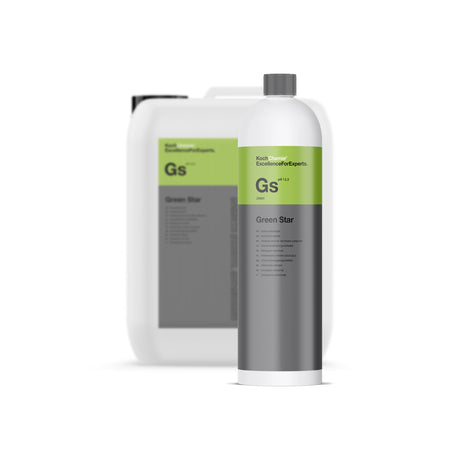
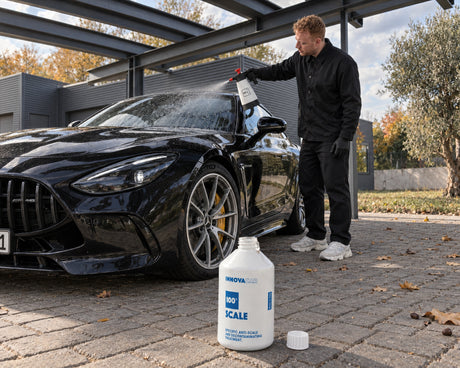
Togliere le macchie di calcare dai vetri dell'auto senza graffiarli
Daniel von Detailing1 |


Koch-Chemie × COLOURLOCK
Stucco nero carteggiabile per riparazioni della pelle
Koch-Chemie × COLOURLOCK
Stucco bianco per pelle, per riparazioni lisce
What are COLOURLOCK Leather Fillers? Paste-like, finely sandable repair compounds for cracks, holes, and abraded areas in pigmented smooth leather and many types of artificial leather. Black for dark leather, white for light leather. They remain elastic after drying and form the base layer onto which leather dye and top coat are applied.
COLOURLOCK Leather Fillers are paste-like repair compounds that replace missing substance in the leather: cracks, holes, chipped edges, and abraded seat bolsters. They replace neither dye nor glue, but rather the material underneath. COLOURLOCK "Filler" (Black) works on dark leather, while COLOURLOCK "Filler" (White) works on light leather. Both remain flexible, can be sanded smooth after drying, and then support the dye layer.
Pro-tip from Detailing1: The most common mistake is applying a thick layer. We regularly receive inquiries about repair sites that tore open again after a few weeks, and almost always the crack was filled to the brim in one go. As it dries, every filler shrinks slightly, the surface sinks, and the crack flanks become visible again. Two to three wafer-thin layers with intermediate drying and light sanding last much longer than one thick layer. And a crack in the seat bolster on the driver's side is under tension: no filler alone can handle that. Only a thin piece of fleece on the back takes the tension out of the leather; after that, the filler only seals the surface.
Leather repair rarely fails due to the filling process. It fails because the filled area does not accommodate the movement of the leather.
Pigmented smooth leather has an opaque layer of dye and protection on top of a fiber layer that works under every load. When you sit down, the bolster stretches and springs back. A filler that cures into a hard block has two options in this situation: it tears itself, or it tears out of the leather at its edges. Both look worse after four weeks than the original crack.
Both fillers are therefore formulated for elasticity rather than hardness. The material binds into the roughened leather surface, air-dries, and remains flexible enough to follow typical stretching. For you, this means: the repair does not become rock-hard; after sanding and dyeing, it feels like a firm part of the leather, not like a foreign object on top of it.
The second reason for the paste-like consistency is its stability. Thin repair products run off vertical surfaces before they set. Yet that is exactly where most damage occurs: seat bolsters, door cards, steering wheel rims. The fillers stay exactly where you put them. Anyone needing even more stability can thicken them with the COLOURLOCK "Thickener" without changing the color or elasticity.
This mindset comes from the repair practice that COLOURLOCK originated from. The brand was founded in 1995 at the Lederzentrum and has been supplying upholsterers and detailers for three decades who save brittle seats and faded sofas. Those who deliver repairs daily, only for the customer to call back a year later, formulate differently than someone optimized for quick hardening.
The filler eventually disappears under the leather dye and top coat. Nevertheless, its color decides how many layers you need on top.
COLOURLOCK "Filler" (Black) is fully black-pigmented and is the choice for black and dark leather. On an anthracite seat, a single layer of dye covers the repaired area because the base is already dark. If you use a light filler there, the spot will remain visible as a bright shadow even after two coats of dye — especially under grazing light through the side window.
COLOURLOCK "Filler" (White) does the same in reverse. The white base prevents a dark substrate from showing through beige, cream, or gray leather dye. On light leather, this is the deciding point because light pigments cover significantly worse than dark ones. The practical benefit: you save on dye layers, and the less dye there is on the repair, the less noticeable it feels to the touch.
Both fillers are available in the same container sizes. The 20 ml syringe is sufficient for specific damage on your own car and remains usable for a long time when sealed. The 1000 ml / 1 liter sizes are aimed at detailers and upholsterers who work on several vehicles per week. From the Detailing1 daily routine: for your first crack, the small container is almost always the right choice — opened large containers tend to dry out for occasional users before they are ever used up.
For an intermediate shade that is neither clearly light nor dark, the leather dye that goes on later will decide. If it is darker than medium brown, take black. If it is lighter, take white. Mixing both fillers alternatingly does no good: the shade of the base doesn't have to match perfectly, it just needs to point in the right direction.
Not all fillers are the same. Three products in the repair line look similar but work completely differently.
The Filler is the fine filler. It is used for cracks, scratches with loss of substance, small holes, and abraded areas — anywhere a few tenths of a millimeter of material is missing and the surface needs to be level again. It air-dries without you having to do anything but wait.
The repair compound COLOURLOCK "Leather & Plastic Paste" is the structural level above that. It only cures completely under heat, usually with a heat gun, and becomes significantly firmer and more dimensionally stable than an air-drying filler. In other words: it is intended for edges, fractures, and larger material losses where something needs to be reshaped — on door panels and plastic parts just as on leather. It is too coarse for a fine hairline crack in the seat surface.
The third variant is found in the leather dyes: COLOURLOCK "Binder" (Neutral) is a neutral filling dye for extensively brittle, finely cracked leather. The filler works locally on a single piece of damage; the binder is applied over an entire panel covered in micro-cracks over the years. If an old seat looks like it has a web of fine lines, that is a case for the binder, not the syringe.
The sequence in your mind is simple: if shape is missing, use the paste. If surface is missing, use the filler. If bonding is missing across the entire area, use the binder. Everything together is a level higher in the Fillers & Putties from COLOURLOCK.
The process is always the same, and the sequence determines the result more than the product itself.
Step one is preparation, and it is the most frequently skipped. On maintained leather, there are traces of care products, skin oils, and silicone oils. Filler does not adhere to these; it just lies on top and peels off at the first tug. Therefore, the area is cleaned with a degreaser until the cloth remains clean, and the crack flanks are slightly roughened. If the crack is under tension or gaping, it is first stabilized from behind with leather glue and a thin reinforcing fleece.
Step two is the buildup. Apply a small amount of material to a spatula, the back of a scalpel, or a fine applicator tip, pull it thinly into the crack, and immediately wipe off excess material. Then let it dry, sand lightly, next layer. The first time, you will need half a day for a palm-sized area including all drying times, not because the work takes long, but because waiting is part of it. From the second time on, you know how thin "thin" is and will work much faster.
Step three is sanding, and this is where the real trap lies. Grained leather tolerates only very little removal: if you take away too much, the grain around the repair disappears, and the smooth spot ends up being more noticeable than the original crack. Therefore, we only sand the filler itself and leave the surrounding leather alone as much as possible.
Anyone wanting to replicate the grain exactly needs an embossing set and practice. For most everyday damage, getting the surface flat and matte is enough.
Step four is the dye. The filler is a base layer and must never remain visible. Apply leather dye to the sanded area in thin layers, followed by a top coat with the appropriate gloss level — matte for most car leathers, glossy only where the original is glossy. Without this final step, the repair remains unprotected and will rub off during the next cleaning.
A filler replaces surface. It does not replace substance that is missing from the entire panel.
The line is drawn at the crack length and the condition of the surrounding leather. Short cracks of a few centimeters in leather that is otherwise still stable can be closed permanently. Long cracks in old, brittle leather or cracks in the middle of a heavily used seat surface often do not hold: the leather yields next to the repair, and the next crack simply runs past the filled area.
We receive exactly these cases as inquiries, usually an old driver's seat where the entry bolster has split along its entire length. In those cases, replacing the cover at an upholsterer's is the more honest answer, and we say so.
The second limit is the grain. The filler does not have any structure; it dries smooth. On fine-grained series leather, this is hardly noticeable, but on coarsely grained furniture or classic car leather, it certainly is. Without an embossing set, a visibly smoother area remains, and with very conspicuous grain, this is a result not everyone is satisfied with. We prefer to say beforehand that a repair on such leather will be good, but not invisible.
The third limit concerns open-pored leather. Aniline, nubuck, and suede have no top layer that one could rebuild — the filler soaks into the open pores, darkens, and leaves a spot that looks worse than the damage. There are separate methods for these leathers, but none involving filler.
And a distinction from below: for scratches that only nicked the top layer and did not cost any substance, filler is too much. If you run your fingernail across the scratch and feel no edge, the damage belongs in the leather scratch removers category and not in this one. Filling what isn't missing only makes the area thicker.
The decision comes down to two questions: how deep is the damage, and how light is the leather?
Fine crack, hole, or abraded area in dark leather, substance still intact around it: COLOURLOCK "Filler" (Black), two to three thin layers, sand in between, then dye and seal. The same damage pattern in light or colored leather: COLOURLOCK "Filler" (White) as a color-neutral base, so the light leather dye doesn't have to work against a dark substrate.
If, however, shape is missing — a broken edge, a hole with material loss, a broken plastic panel — you start one step earlier with the heat-curing repair compound and only pull the surface flat with the filler afterward. If the crack is under tension, base reinforcement is always applied first. And anyone starting from zero who doesn't have degreaser, dye, or top coat on their shelf will find the coordinated combination in the repair sets from COLOURLOCK.
The point no manufacturer puts on the packaging: the quality of a leather repair is decided not by the filler, but by the amount you leave out. Anyone who applies the syringe and fills the crack in one go will have the same spot in front of them in four weeks. Anyone who applies almost nothing three times and waits in between will still not see the repair after a year.
Troppa scelta in Riempitivi per pelle di COLOURLOCK? Fatti aiutare a scegliere:
Daniel von Detailing1 |

Daniel von Detailing1 |

Daniel von Detailing1 |

Daniel von Detailing1 |

Jasper von Detailing1 |

Daniel von Detailing1 |

Daniel von Detailing1 |

Daniel von Detailing1 |

Jasper von Detailing1 |

Jasper von Detailing1 |

Daniel von Detailing1 |

Daniel von Detailing1 |